
What San Diego Property Owners Must Track to Stay Compliant (2026 Guide)
By Scott Engle, Broker/Owner – Realty Management Group | Last updated January 2026
San Diego County rental compliance is a tracking system: rent rules, notices, repairs, HOA restrictions, and documentation. Owners who track these consistently avoid most preventable disputes, delays, and costly mistakes.
🔑 Quick Answers: What San Diego County Property Owners Must Track to Stay Compliant
- Track rent and fee rules (caps, increases, timing, and required disclosures) based on your property type and location within San Diego County.
- Track notice requirements (entry, rent change, lease violations, and terminations) including delivery method and proof of service. This is especially critical when it comes to enforcing lease violations in San Diego County, where proof of service and timing errors routinely invalidate notices.
- Track habitability and repair timelines (response, vendor access, completion, and written records) to reduce disputes and liability exposure.
- Track HOA restrictions (rental caps, approvals, lease terms, move-in rules, fines) if your property is in an association.
- Track recordkeeping (screening criteria, lease files, notices, invoices, inspection notes) so you can prove compliance if challenged.
Summary
Staying compliant as a San Diego rental owner is less about memorizing laws and more about tracking the right items consistently. San Diego County includes the City of San Diego, other incorporated cities, and unincorporated areas, and requirements can differ depending on where the property is located. San Diego rental rules can change during the year, which makes ongoing tracking more important than “one-time compliance.” Most compliance problems are tracking failures: missed deadlines, incorrect notices, undocumented repairs, or assumptions that an HOA rule (or a local rule) doesn’t apply. This guide breaks down what San Diego County property owners should track year-round and how a professional property manager reduces risk with repeatable systems and documentation.
Fee disputes often escalate when surprise property management fees are charged without clear documentation, approval, or a traceable service record tied to compliance requirements.
When tracking breaks down, owners often slip into “shadow management” just to verify timelines and documentation—one of the clearest warning signs of deeper operational failure outlined here: 7 warning signs of bad property management in San Diego.
Direct Answer: What must San Diego County property owners track to stay compliant?
Yes. San Diego County property owners must actively track rent rules, required notices, habitability and repair timelines, HOA restrictions (if applicable), and clear documentation for each step to remain compliant and avoid preventable disputes, delays, and penalties.
This guide is written by a California-licensed real estate broker (licensed in California since 2003) with over 20 years of experience managing HOA-governed rentals across San Diego County, providing deep expertise in legal compliance and long-term asset performance.
Field Note From a San Diego Property Manager
In my 20+ years managing San Diego County rentals, most “compliance issues” I see are not intentional violations. They happen when owners miss a timing requirement, use the wrong notice delivery method, or can’t prove what happened because the file is incomplete.
The fastest way to reduce risk is to treat your rental like an asset with a checklist: track dates, save proof, and document decisions.
Mini Case Study: The Tracking Failure That Would Have Delayed Leasing
- Problem: Owner accepted an application and planned move-in before confirming HOA rental eligibility.
- Risk: If the HOA was at its rental cap, the lease could have been delayed or blocked, causing vacancy and disputes.
- Intervention: We verified HOA rental status first, confirmed the approval steps, and documented the HOA requirements in the lease file.
- Result: A clean move-in timeline and a documented file that reduced the chance of HOA-driven delays and misunderstandings.
Jump To
- Compliance tracking checklist (Monthly / Quarterly / Annual)
- Rent rules San Diego County owners must track
- Notices: timing, delivery, and proof of service
- Habitability repairs: response and documentation
- HOA restrictions: rental caps, approvals, lease terms
- Recordkeeping: what to save and why it matters
- Why location matters inside San Diego County
- FAQs

San Diego County Compliance Tracking Checklist (Copy/Paste)
Use this checklist to keep your rental file current. It’s designed to reduce preventable disputes by making sure key deadlines, notices, and documentation are tracked.
Monthly
- ☐ Confirm rent ledger matches payments and charges; note any irregularities.
- ☐ Review open maintenance items; document status, vendor scheduling, and access notes.
- ☐ Verify any served notices are saved with proof of service (what/when/how/to whom).
- ☐ Confirm the lease file has current tenant contact info and emergency contacts (if collected).
Quarterly
- ☐ Re-check property jurisdiction (City of San Diego vs other city vs unincorporated) and note it in the file.
- ☐ Audit your notice templates for current requirements and delivery standards.
- ☐ Review HOA rules if applicable: rental cap status, approval steps, lease term minimums, and move-in requirements.
- ☐ Confirm your screening criteria and documentation are consistently applied and saved.
Annually (or before renewal)
- ☐ Review rent strategy and compliance timing before any change takes effect.
- ☐ Confirm disclosures and addenda are current for your property type and location.
- ☐ Perform a file completeness check: lease, disclosures, notices, repair log, invoices, and deposit documentation.
- ☐ If HOA-governed, confirm rental eligibility before marketing or accepting applications.
Rent rules owners must track in San Diego County
Compliance starts with what you can charge and how you can change it. In San Diego County, rent and fee rules can vary based on property characteristics, exemptions, and jurisdiction. The most common failure isn’t the rent number—it’s timing, notice language, and whether the correct rule set applies to your unit.
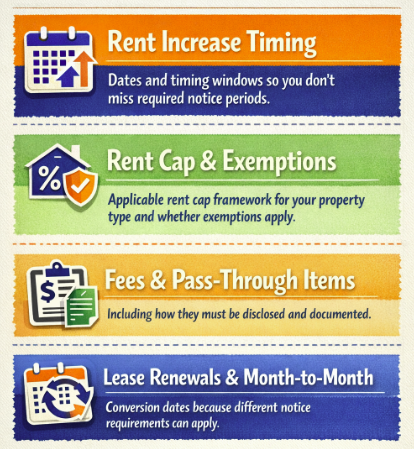
What to track (minimum)
- Rent increase dates and timing windows so you don’t miss required notice periods.
- Applicable rent cap framework for your property type and whether exemptions apply.
- Fees and pass-through items including how they must be disclosed and documented.
- Lease renewal and month-to-month conversion dates because different notice requirements can apply.
If you manage multiple properties across the county, treat compliance as a system, not a spreadsheet. Owners often benefit from location-specific guidance through San Diego property management and high-HOA areas like Mission Valley property management.
Notice requirements and proof of service
Notices are where DIY owners lose leverage. A notice can be “true” and still fail if it’s delivered improperly, missing key language, or not documented. If a dispute escalates, your ability to prove service and timing is often the deciding factor.
Notices to track (and document)
- Entry notices (date/time, service method, reason, and who entered).
- Rent change notices (effective date, service date, and proof of delivery).
- Lease violation / performance notices (issue description, cure requirements, supporting documentation).
- Termination notices (jurisdiction-sensitive; timing and language are critical).
Operational rule: every notice should have a corresponding file entry showing what was served, when, how, and to whom, plus a copy of the notice that was actually delivered.
Habitability, repairs, and response timelines
Habitability isn’t a single repair—it’s a timeline with documentation. Owners commonly do the right thing (call a vendor) but fail to track the chain: tenant report, response, vendor scheduling, access coordination, completion, and written confirmation.
What to track for repairs
- Date/time of tenant report and how it was received (text/email/portal).
- Response time and the action taken (triage, safety guidance, vendor assignment).
- Access attempts (entry notices if needed, scheduling notes, vendor visit confirmations).
- Completion evidence (invoice, completion notes, and tenant confirmation when appropriate).
- Follow-up confirming the issue is resolved and documenting the outcome.
This is also where local market expectations differ. Owners often want area-specific help in family-heavy submarkets like Chula Vista property management and growing corridors like Escondido property management.
HOA restrictions: rental caps, approvals, lease terms
If your property is in an HOA, you are managing two systems at once: landlord-tenant rules and HOA governance. Owners run into avoidable delays when they sign a lease before confirming the HOA’s rental eligibility requirements or approval timelines.
What HOA-governed owners must track
- Rental caps and waitlists and the steps to confirm eligibility before marketing.
- Approval requirements including documents, timelines, and who must submit them.
- Minimum lease terms and restrictions that affect rental strategy.
- Move-in rules (deposits, elevator reservations, parking rules, orientations).
- Fines and enforcement policies and how violations are handled.
In HOA-heavy coastal and north county inventory, these details can determine whether your unit can be rented on your desired timeline. That’s a common reason owners seek localized support such as Oceanside property management.
If your rental is in an association, review the rules before marketing the unit. Here’s our full guide to Mission Valley HOA rental rules & restrictions.
Recordkeeping that protects owners
Compliance is hard to prove without records. The goal is not paperwork for its own sake—it’s a clean audit trail and owner visibility showing you acted reasonably, consistently, and within required timeframes.
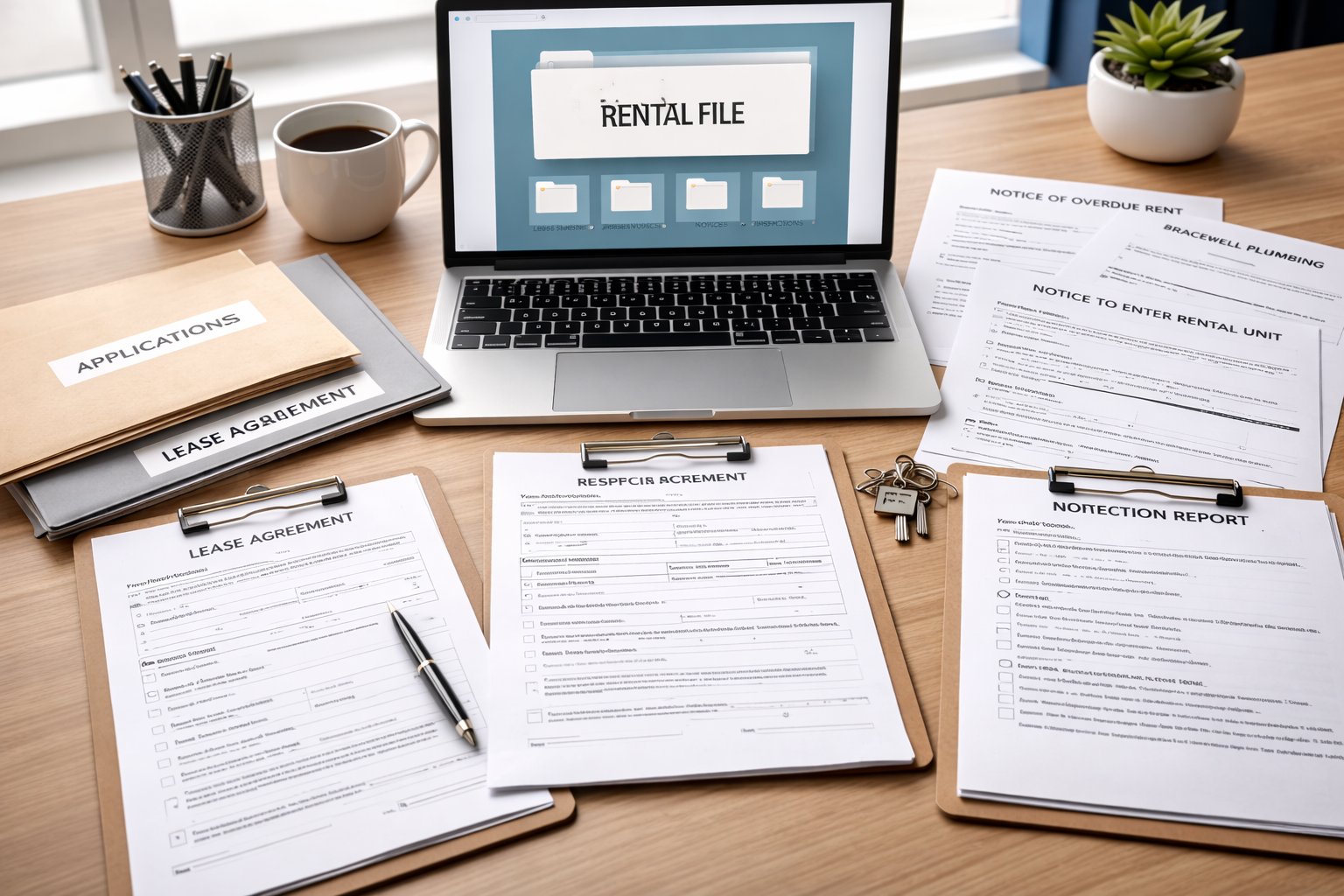
Owner file checklist (baseline)
- Lease package (signed lease, addenda, disclosures, HOA rules acknowledgment if applicable).
- Screening documentation (criteria, application timestamps, and decision records).
- Notice log (copies of notices, service method, and proof of service).
- Repair log (report, response, vendor invoices, completion notes).
- Financial records (ledger, invoices, owner statements, deposit accounting).
Strong documentation also supports refinancing, insurance claims, and smoother turnovers.
County-wide compliance: why location matters inside San Diego County
“San Diego” can mean the City of San Diego, another incorporated city in the county, or unincorporated areas. That matters because local rules and enforcement practices can differ. Owners who manage across multiple areas should track jurisdiction the same way they track lease dates.In San Diego, these breakdowns are often the same warning signs owners later use to decide when to fire a property manager.
A simple rule that prevents expensive mistakes
Before serving a notice, changing rent, or making a high-impact decision, confirm: (1) property location/jurisdiction, (2) property type, (3) HOA status, and (4) current lease status. If any of those are wrong, the action can become non-compliant even when your intent is reasonable.
San Diego County compliance note
This article is general educational information for San Diego County rental owners and is not legal advice. Rental laws and ordinances can change, and your property details can affect which rules apply. If you want a property-specific compliance review, we can help you evaluate your situation with documentation and jurisdiction in mind.
FAQs: San Diego County Rental Compliance Tracking
What is the most important thing San Diego County property owners must track to stay compliant?
The most important item is timing and documentation: rent changes, required notices, and repair timelines should be tracked with proof of service and clear records.
Do San Diego County property owners have to track HOA rules if they already follow California landlord-tenant laws?
Yes. If your property is in an HOA, you must track both systems. HOA rental caps, approval processes, and lease term restrictions can affect whether you can rent the unit on your timeline.
What is the most common San Diego County compliance mistake owners make with notices?
The most common mistake is serving a notice without tracking the correct timing, the correct delivery method, and proof of service. A notice can fail even when the underlying issue is legitimate.
How should San Diego County property owners track repairs to reduce disputes?
Track the full chain: tenant report, response, vendor scheduling, access coordination, completion evidence, and written follow-up confirming resolution.
Does the tracking strategy change for owners with rentals across San Diego County?
Yes. Owners operating in multiple jurisdictions should track property location/jurisdiction as a compliance variable, alongside lease status and HOA requirements.
Related San Diego Rental & HOA Guides
- What Accidental Landlords Should Know in San Diego County: Complete 2025 Guide
- San Diego Property Management Fees: Flat Fee vs. Percentage
- Mission Valley HOA Rental Rules & Restrictions: What Owners Must Know
- HOA Waitlists Explained: How Long Can Owners Be Blocked From Renting?
- Notice Workflow for San Diego Rentals: How to Document Compliance
Bottom Line
San Diego County rental compliance is a tracking game. When owners consistently monitor rent rules, notice requirements, repair timelines, HOA restrictions, and documentation, disputes drop and cash flow stabilizes. When tracking breaks down, owners lose time, leverage, and often money—even when they acted in good faith.
Request a Free San Diego County Rental Compliance Review
Want a property-specific checklist for what you should be tracking right now—based on your jurisdiction, property type, lease status, and HOA requirements?
Request a Free San Diego County Rental Compliance Review and we’ll help you identify risk points before they become costly problems.
Contact & Resources
For county-wide support, explore our local teams here: San Diego, Mission Valley, Chula Vista, Escondido, and Oceanside.
Primary Sources (Official References)
Prefer a quick call? Contact Realty Management Group and ask for a Rental Eligibility & Compliance Review.
Why Choose Realty Management Group
- Compliance-first management: tracking systems and documentation built into daily operations.
- San Diego County coverage: local expertise across multiple cities and HOA-heavy communities.
- Owner clarity: simple reporting, consistent communication, and a process you can trust.