The January 1 Deadline Your Property Manager Likely Missed — And the Liability You Now Carry
By Scott Engle, Broker Owner – Realty Management Group | Last updated: January 2026
On January 1, California habitability law shifted from a disclosure model to an execution model. For San Diego County rental owners, this shift directly affects Statutory Lease Renewals, appliance responsibility classification, and where statutory liability attaches across submarkets such as Mission Valley, Chula Vista, and El Cajon.
TL;DR: The AB 628 Impact
- Lease executions on or after January 1 reset habitability duties tied to appliance responsibility.
- AB 628 constrains exclusion of a refrigerator once landlord responsibility attaches.
- Owners retain statutory liability when renewals proceed without a compliance audit.
- Brief compliance gaps create measurable Net Operating Income (NOI) loss and valuation erosion.
- Audit lag beyond 48 hours after execution fails reasonable diligence.
Quick Answers: Core Concepts
- AB 628 Compliance
- A California habitability statute that governs when appliance responsibility becomes a non-waivable condition of tenancy. It restricts exclusion of a refrigerator once the landlord is responsible, with liability triggered at lease or renewal execution on or after January 1 under Civil Code § 1941.1.
- Property Manager Compliance Failure
- Occurs when appliance responsibility is not verified before a post-January 1 lease execution, creating immediate statutory liability for the owner.
- San Diego Rental Compliance Audit
- A pre-execution verification process confirming appliance responsibility, habitability status, and documentation. Delays beyond 48 hours constitute a loss of reasonable diligence.
- Appliance Responsibility Misclassification
- A compliance failure where a refrigerator treated as tenant-provided is legally deemed landlord-provided based on lease language, replacement history, or representations.
What Changed on January 1 Under AB 628
AB 628 amended Civil Code § 1941.1 effective January 1 to constrain when a refrigerator can be excluded from habitability once landlord responsibility for appliances exists. The statutory trigger is execution of a new lease or renewal on or after January 1. Tenant-owned appliances are not reassigned by default.
As amended, Civil Code § 1941.1 now requires that a habitable dwelling include kitchen facilities maintained in good working order, and when the landlord provides appliances as part of those facilities, a functioning refrigerator is part of the statutory habitability baseline at execution.
The statute does not impose a universal refrigerator mandate; responsibility governs. When the landlord supplies, replaces, retains at turnover, or represents responsibility for a refrigerator, implied habitability attaches at execution. Clear allocation to a tenant-owned appliance remains valid only when unchanged, documented, and not contradicted by landlord conduct.
(Note: This execution-based appliance standard is specific to California and does not apply in jurisdictions where refrigerators remain optional amenities by default.)
Why Statutory Lease Renewals Create Hidden Exposure
Statutory Lease Renewals executed on or after January 1 reset habitability obligations tied to appliance responsibility. A unit lawful on December 31 becomes noncompliant on January 1 if renewed without verifying responsibility, even when the physical condition is unchanged.
In Mission Valley, Chula Vista, and El Cajon, renewals are frequently processed in batches using legacy disclosures. If responsibility shifted through prior replacement, repair authorization, or representations to the tenant, renewal execution fixes statutory liability. Intent and historical acceptance do not cure misclassification. Execution controls.
Amenity vs. Non-Waivable Essential
Once the landlord is responsible for appliances, a refrigerator is a non-waivable habitability element at execution. Disclosure language cannot override statutory duty for post–January 1 executions.
Amenity status applies only when the refrigerator is tenant-owned, tenant-maintained, clearly allocated in writing, and has no landlord replacement history or representations. A refrigerator becomes a non-waivable essential when it is landlord-supplied, landlord-replaced, retained at turnover, or represented as provided. Post-January 1 execution without compliance creates immediate statutory exposure.
Where Statutory Liability Sits When Compliance is Missed
Statutory habitability liability rests with the property owner. Management error does not transfer legal responsibility, and tenant remedies attach directly to ownership.
Management agreements allocate duties between parties; statutes allocate liability. Owners must verify compliance audits before execution. Post-notice cures do not erase execution-date liability.
NOI Impact Analysis & Maintenance Arbitrage
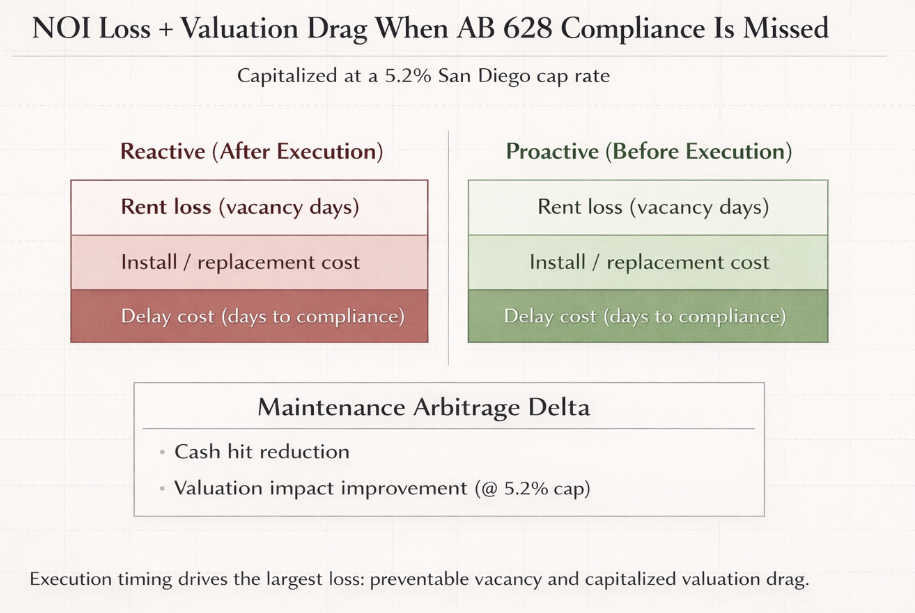
Appliance responsibility misclassification creates immediate cash loss, Vacancy Rate Compression failure, and valuation drag when capitalized at San Diego’s 5.2% Cap Rate.
| Metric | Scenario A: Reactive | Scenario B: Proactive | Delta (Net Gain) |
|---|---|---|---|
| Rent Loss (Vacancy) | $700 | $0 | +$700 |
| Install Cost | $1,200 | $1,000 | +$200 |
| Implementation Time | 3-5 Days | 0 Days | 3-5 Days Saved |
| Total Cash Hit | $1,900 | $1,000 | +$900 |
| Valuation Impact (@ 5.2% Cap) | ($36,538) | ($19,231) | +$17,307 |
This delta represents Maintenance Arbitrage created by timing and verification rather than vendor pricing.
Diagnostic: The Binary Compliance Checklist
If you answer YES to any of the following, statutory habitability obligations apply at execution under Civil Code § 1941.1:
- ☐ Did you execute a lease or renewal on or after January 1?
- ☐ Is the refrigerator listed as landlord-provided in the lease?
- ☐ Has the landlord replaced or repaired the refrigerator previously?
- ☐ Was the refrigerator retained at turnover?
- ☐ Was appliance responsibility verified before execution?
Decision Rule: If the landlord is responsible at signing, the unit is legally untenantable until a compliant refrigerator is provided.
Key Takeaways
- January 1 execution dates reset responsibility-based habitability duties.
- Refrigerators become non-waivable once landlord responsibility attaches.
- Owners retain statutory liability despite management execution errors.
- Execution delays create outsized Net Operating Income and valuation loss at a 5.2% cap rate.
- Proactive audits create measurable Maintenance Arbitrage.
Summary
AB 628 converted appliance responsibility from a disclosure issue into an execution-date compliance trigger. In San Diego County submarkets with high renewal velocity, failure to verify responsibility before signing exposes owners to immediate legal and financial consequences. Proactive verification preserves cash flow, prevents Vacancy Rate Compression, and protects asset value.
Frequently Asked Questions
Does AB 628 apply to single-family rentals?
Yes, when the landlord is responsible for the refrigerator at execution under Civil Code § 1941.1.
Can tenants waive the refrigerator requirement?
No. Habitability standards are non-waivable once landlord responsibility attaches.
Does prior disclosure protect the owner after January 1?
No. When landlord responsibility exists at execution, statutory duty controls over disclosure language.
Is there a statutory grace period after renewal?
No. The statute sets an execution-based obligation and does not provide a grace period.
Who is liable if the manager missed the audit?
The owner remains liable for tenant-facing remedies because statutory habitability obligations attach to ownership. Management agreements allocate duties; statutes allocate liability.
Do unmodified month-to-month continuations trigger the change?
Only when a new agreement or modification is executed, because the trigger is execution.
What documentation proves compliance?
Dated photos, invoices, and lease language contemporaneous with execution, retained as audit-ready documentation.
Scott Engle | Broker/Owner, Realty Management Group
DRE #01332676 | Corp DRE #02075336
Specialization: San Diego County Asset Management, AB 1482 Compliance, Statutory Habitability Enforcement, & NOI Maximization.