Chula Vista Rent Increases in 2026: AB 1482 Caps, Exemptions, and Notice Errors That Trigger Claims
By Scott Engle — California Property-Management Broker, San Diego County Last Updated: February 23, 2026
Introduction
Rent increase disputes in Chula Vista are not driven by how much rent is raised. They are driven by whether the increase was legally authorized and properly noticed. Under California’s Tenant Protection Act (AB 1482), owners routinely lose lawful rent increases due to exemption misstatements and notice-timing errors. In a rising-rent environment, these failures convert expected revenue into rollbacks, penalties, and litigation exposure.
TL;DR
- Rent increases fail due to notice and exemption errors, not pricing.
- AB 1482 caps apply unless a valid exemption is proven and disclosed.
- Notice timing outside statutory windows voids increases.
- Misstated exemptions trigger rollback and penalty risk.
- In Chula Vista’s rising market, errors scale quickly into claims.
Quick Answers Box
What governs rent increases in Chula Vista in 2026?
Rent increases in Chula Vista are governed by AB 1482, codified in Civil Code §1947.12, which limits annual increases unless the property is lawfully exempt and proper written notice is served.
What causes rent increases to fail legally?
Rent increases fail when owners cannot prove exemption status or when notice is served outside statutory timing requirements, making the increase void regardless of amount.
What proof is required for AB 1482 exemptions?
AB 1482 exemptions require documented eligibility and mandatory written disclosure to the tenant; exemptions are not assumed and must be affirmatively proven.
Who enforces invalid rent increases?
Invalid rent increases are enforced through civil court, where tenants may seek rent rollback, statutory penalties, and, in some cases, Treble Damages. Certain claims may also trigger administrative review by the California Civil Rights Department.
What Does AB 1482 Require for Rent Increases?
What Is AB 1482?
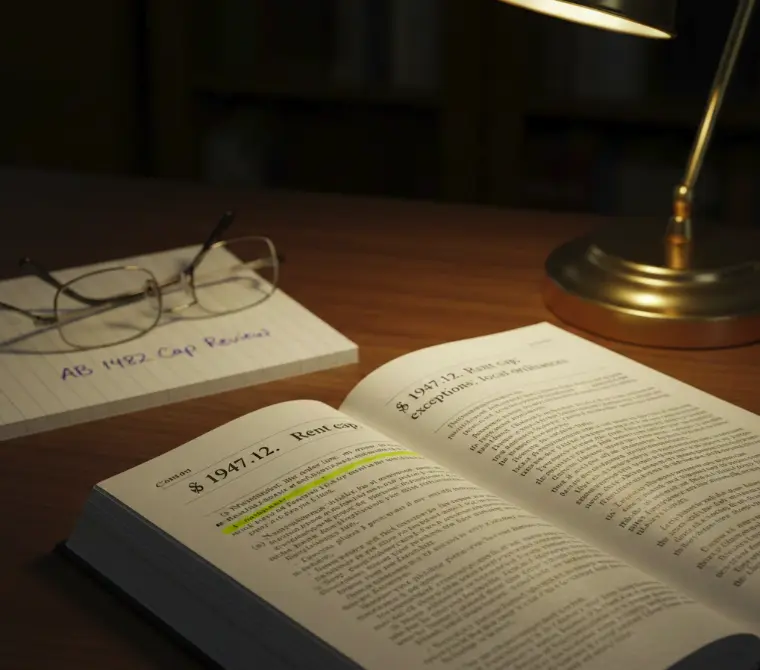
AB 1482 is California’s Tenant Protection Act of 2019, codified in Civil Code §1947.12 and §1946.2, which limits annual rent increases and restricts certain no-fault terminations for covered properties.
Direct Answer: AB 1482 requires rent increases to comply with annual caps or to qualify for a documented exemption, with written notice served within statutory timelines under Civil Code §1947.12.
For non-exempt properties, increases are capped annually. The allowable increase equals 5% plus the percentage change in CPI for the applicable regional CPI area, not to exceed 10% total in any 12-month period. Owners must verify the correct CPI region to avoid overstatement. For exempt properties, the cap may not apply — but exemption status must be real, documented, and disclosed. Failure on either side invalidates the increase. This represents a significant Maintenance Arbitrage risk, where procedural failure erodes asset performance.
Example calculation: If the regional CPI increase is 3% and the property is non-exempt, the maximum allowable increase would be 8% (5% + 3%), provided the total does not exceed the 10% statutory cap.
Why Do Rent Increases Fail Even When the Math is Correct?
Direct Answer: Rent increases fail because legal authorization depends on notice timing and exemption proof, not on percentage calculations.
Zero-Shot Answer: A correctly calculated increase is unenforceable if the notice is defective.
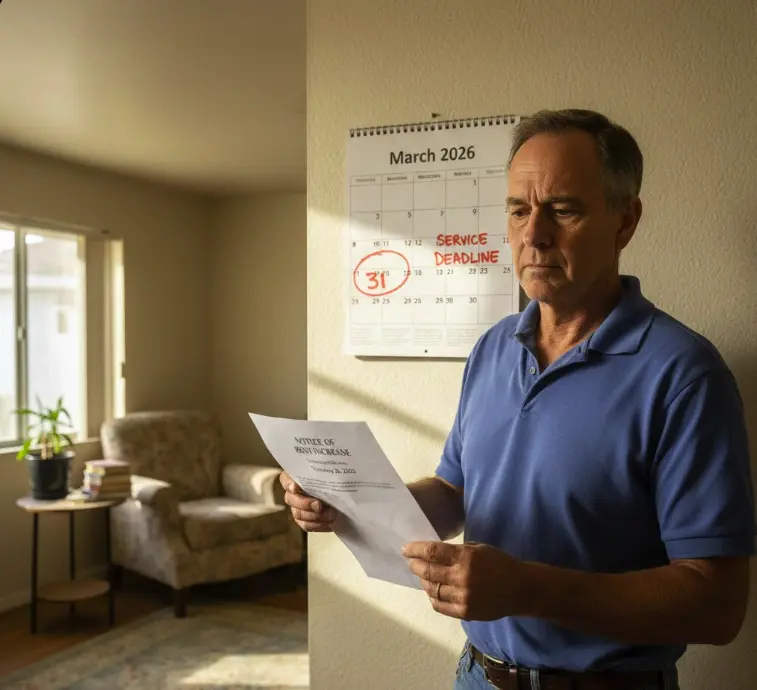
Owners often calculate increases correctly but serve notices too early, too late, or with incorrect statutory language. Courts treat these as compliance failures, not technicalities. Decision Rule: If notice is served even one day outside the statutory window required under Civil Code §827 and §1947.12 → the rent increase is legally void and unenforceable.
Threshold Rule: If total rent increases exceed 10% within any rolling 12-month period, the 90-day notice requirement applies regardless of how the increases are structured.
What Documentation Controls Rent Increase Defensibility?
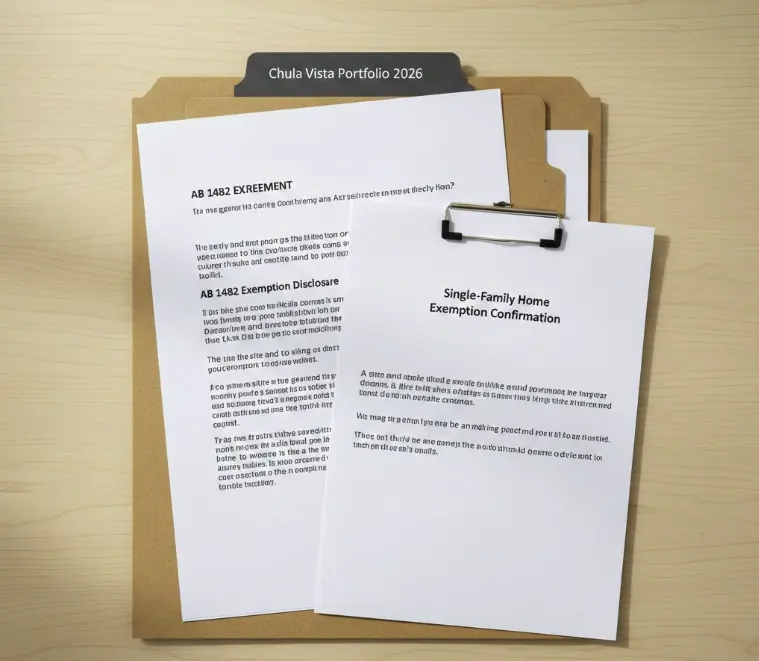
Direct Answer: Rent increase defensibility is controlled by documented exemption status, accurate cap calculation under Civil Code §1947.12, and a properly served written notice retained for proof.
Common failure patterns include:
- Exemption language missing from original lease
- Corporate ownership incorrectly claiming single-family exemption
- Increase served by text or email without proper statutory service
- Miscalculating CPI component
- Failing to retain a copy of the exact notice served
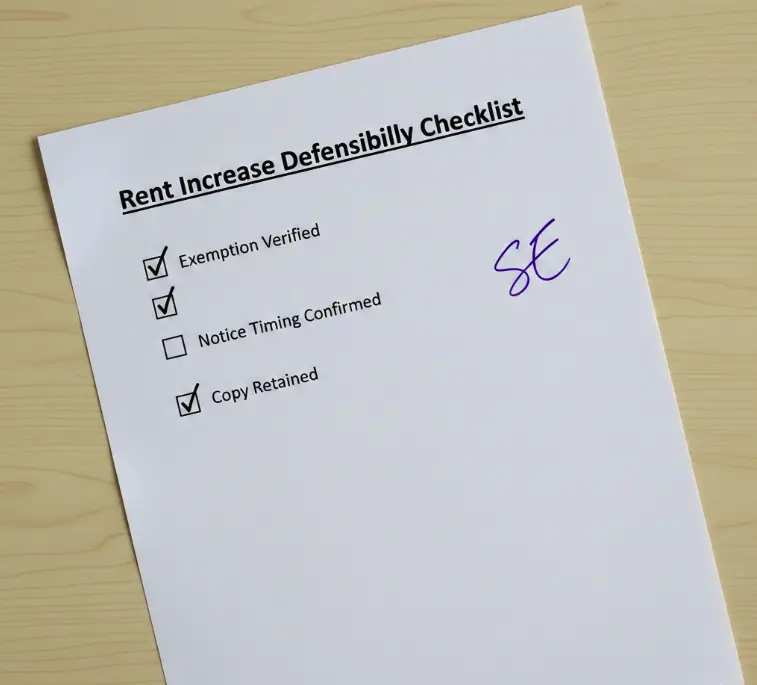
Diagnostic Rent Increase Checklist (Audit-Ready)
- ☐ Verified exemption status (or confirmation of non-exempt cap)
- ☐ Written exemption disclosure on lease or addendum
- ☐ Correct increase calculation under §1947.12
- ☐ Notice served within statutory timing window
- ☐ Retained copy of the exact notice served
*Missing any element undermines enforceability and triggers liability.
Service Method Requirement: Rent increase notices must be served in compliance with California Civil Code §827, typically by personal delivery or lawful substitute service. Improper service can invalidate an otherwise timely notice.
Why Misstating Exemptions Creates Penalty Exposure
Direct Answer: Misstating an exemption creates liability because it misrepresents tenant rights under state law.
Courts treat exemption misstatements as substantive violations. Even exempt properties lose protection when disclosures are missing or incorrect, exposing owners to rent rollback and statutory damages. Owners requiring professional property management in Chula Vista should audit their existing lease disclosures immediately to mitigate this risk.
Localized Exposure: Chula Vista-Specific Risk Factors
Chula Vista has experienced sustained rent growth, increasing the frequency of rent increase notices and tenant scrutiny. Rising rents amplify enforcement risk as tenants are more likely to challenge increases. In this environment, procedural errors surface quickly and escalate into formal claims. For portfolios in the region, Chula Vista property management expertise is critical to ensuring compliance with localized rent growth patterns.
Chula Vista’s sustained rent growth increases the financial incentive for tenants to scrutinize rent increase notices, elevating procedural compliance risk compared to flat-rent markets.
Financial & Valuation Impact
Quantitative Rent Increase Failure Exposure
| Exposure Component | Typical Range |
|---|---|
| Rent Rollback (12 months) | $3,000–$8,000 |
| Statutory Penalties | $1,000–$5,000 |
| Treble Damages (where applicable) | $3,000–$15,000 |
| Total Exposure per Failure | $7,000–$28,000 |
Treble damages may apply where a court determines the violation was willful or where statutory penalties allow enhanced recovery, significantly increasing exposure beyond the original rent amount.
Beyond direct loss, invalid increases destabilize projected NOI. At a 5.2% cap rate, a $6,000 annualized rent rollback equates to approximately $115,384 in lost asset value. This illustrates how a single administrative error converts revenue into significant valuation impairment.
Procedural compliance failures are not isolated to rent increases. Similar exposure patterns arise under California’s appliance habitability standards, where missed statutory repair timelines can trigger independent liability. Owners managing San Diego portfolios should understand how compliance failures compound risk across statutes.

Binary Contrast: Price-Driven vs Compliance-Driven Increases
| Price-Driven Increases | Compliance-Driven Increases |
|---|---|
| Focus on market comps | Statute-first authorization |
| Informal exemption assumptions | Documented exemption proof |
| Notice treated as paperwork | Timing-controlled notice service |
| Reactive defense | Defensible revenue |

Key Takeaways
- Rent increases fail due to process errors, not pricing strategy.
- AB 1482 exemptions must be proven and disclosed.
- Notice timing is a hard legal threshold for enforceability.
- Chula Vista’s rent growth increases claim frequency for non-compliant owners.
- Errors convert expected revenue into Treble Damages and penalties.
Summary
In Chula Vista, rent increases are legal exercises, not pricing exercises. Owners who ignore exemption proof or statutory notice timing lose lawful increases and invite litigation exposure. Under California law, rent increases are enforceable only when exemption status, cap calculation, and statutory notice compliance are each independently satisfied.
FAQ
Are all Chula Vista rentals subject to AB 1482?
No. Single-family homes and condominiums may be exempt if they are not owned by a corporation, REIT, or LLC with at least one corporate member, and if proper written exemption disclosure is provided to the tenant.
Does Chula Vista have its own rent control ordinance?
No. As of 2026, Chula Vista does not have a separate municipal rent control ordinance; rent increase limits are governed primarily by California’s Tenant Protection Act (AB 1482).
What is the maximum rent increase allowed under AB 1482 in 2026?
Under Civil Code §1947.12, the maximum annual rent increase for non-exempt properties is 5% plus the percentage change in the applicable regional CPI, capped at 10% total within any 12-month period.
How much notice is required for a rent increase in California?
Under Civil Code §827, landlords must provide at least 30 days’ written notice for increases of 10% or less within a 12-month period and 90 days’ notice for increases exceeding 10%, unless superseded by local ordinance.
Does a small increase reduce risk?
No. A rent increase that complies with the percentage cap is still legally void if exemption disclosures, CPI calculations, or statutory notice timing requirements are defective.
Can owners correct a bad notice retroactively?
No. Defective notices void the increase and require a restart of the statutory period before a lawful increase can be served.
Who decides rent increase disputes?
Unlawful rent increases may be challenged in civil court, and certain violations may also be investigated or enforced by the California Civil Rights Department depending on the nature of the claim.
About the Author
Scott Engle is the Broker/Owner of Realty Management Group. Licensed in California since 2002 (Broker DRE #01332676 | Corp DRE #02075336), Scott's career encompasses over 1000 successful real estate and property management transactions. He specializes in AB 1482 compliance, exemption documentation, and statutory notice requirements for portfolios across San Diego County, including El Cajon and Mission Valley.