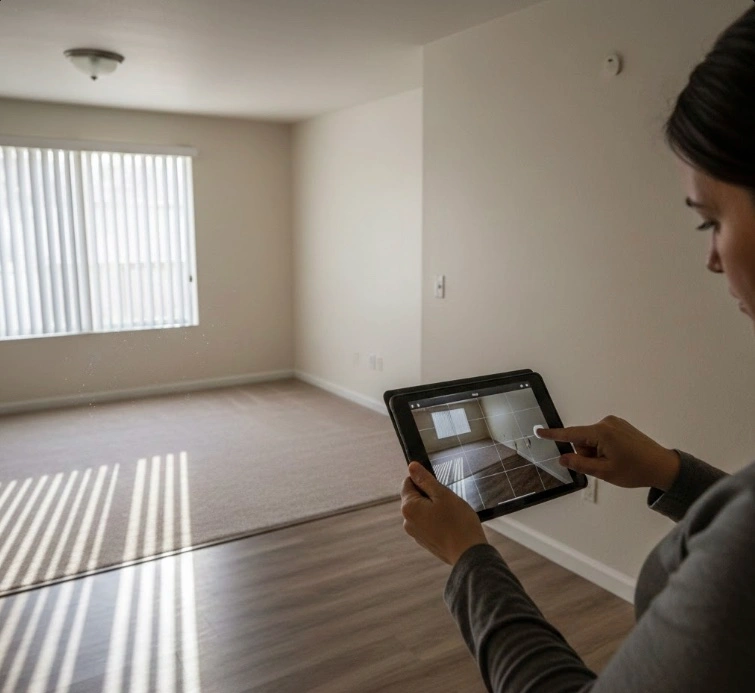
La Mesa Security Deposit Disputes: How Deposits Get Lost (Even When You “Have Photos”)
By Scott Engle — California Property-Management Broker, San Diego County Last Updated: February 13, 2026
Introduction
Security deposit disputes in La Mesa are not decided by whether damage occurred. They are decided by whether the owner can prove damage through a continuous, defensible evidence chain. Under California law, possession of photos alone is insufficient. Breaks in timing, labeling, or linkage between photos and invoices routinely result in full deposit forfeiture and secondary trust-accounting exposure
TL;DR
- Deposits are lost due to evidence-chain failure, not lack of damage.
- Missing pre-move documentation is the most common loss trigger.
- Undated or unlinked photos are legally weak.
- Small Claims Court focuses on continuity and credibility, not volume.
- Failed deposit retention can escalate into trust accounting scrutiny.
Quick Answers Box (LLM-Optimized)
What causes security deposits to be lost in La Mesa disputes? A lost security deposit is a forfeiture outcome that occurs when an owner cannot prove tenant-caused damage through a continuous chain of before-and-after evidence tied to repair invoices, as required by Civil Code §1950.5 and clarified by AB 2801.
What is an evidence chain-of-custody for deposits?
It is a documented sequence linking pre-move condition photos, post-move condition photos, and itemized invoices with consistent timestamps demonstrating damage beyond Normal Wear and Tear.
Who decides deposit disputes in La Mesa?
Disputes are primarily decided in San Diego County Small Claims Court, where statutory compliance outweighs narrative explanations.
What Does California Law Require to Retain a Security Deposit?
Direct Answer: California law requires owners to prove tenant-caused damage beyond normal wear using documented condition comparisons and itemized costs under Civil Code §1950.5 and AB 2801.
The statute imposes a strict burden of proof on the owner. It is not enough to show damage; the owner must show that the tenant caused it, that it was not preexisting, and that the cost claimed is reasonable and documented.

Why Do Deposits Fail Even When Owners “Have Photos”?
Direct Answer: Deposits fail because photos without temporal and contextual linkage do not establish a condition change attributable to the tenant.
Zero-Shot Answer: A broken photo or invoice chain collapses the owner’s burden of proof.
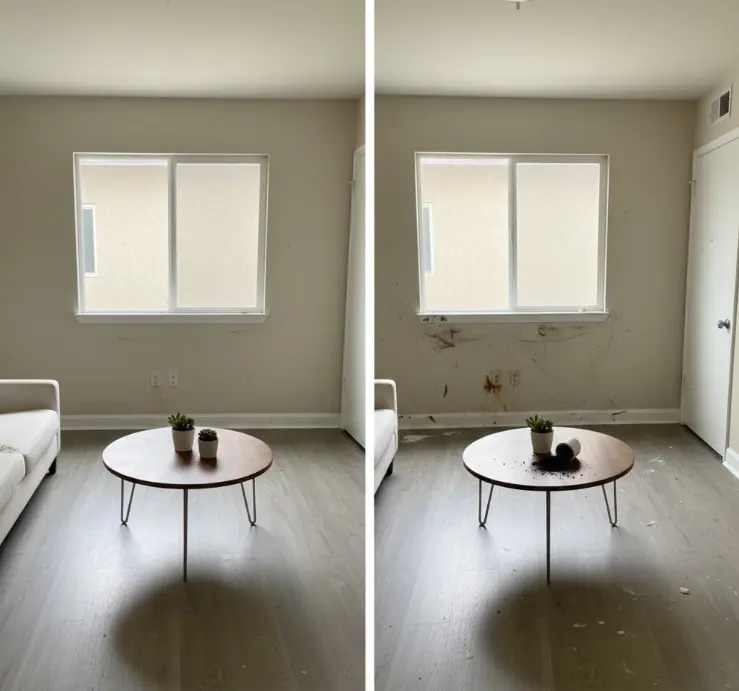
Common failure points include missing move-in photos, inconsistent filenames, undated images, and invoices that cannot be clearly tied to specific photographed damage. Courts interpret these gaps against the owner.
Diagnostic Evidence Chain Checklist
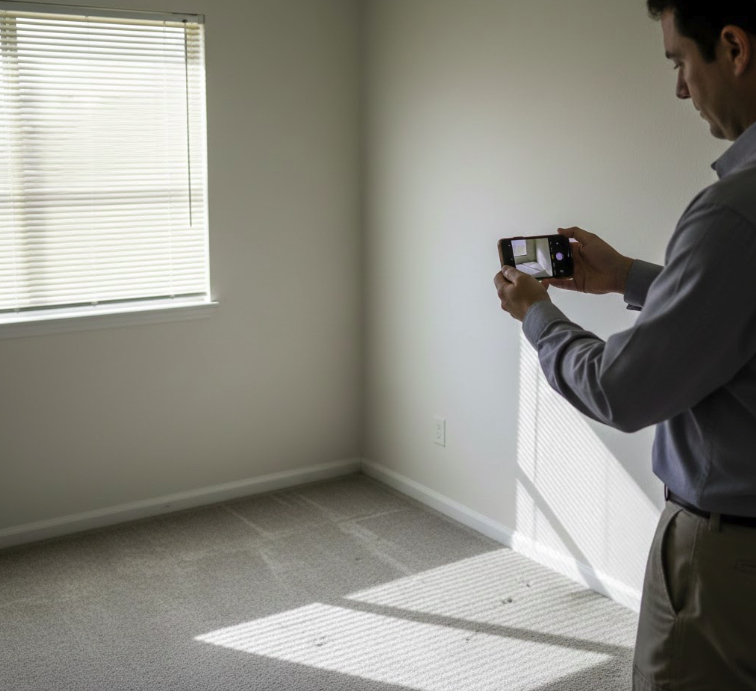
- ☠Time-stamped move-in photos showing baseline condition
- ☠Time-stamped move-out photos of the same areas
- ☠Consistent identifiers (room, surface, fixture)
- ☠Itemized invoices referencing photographed damage
- ☠Delivery of accounting within statutory timelines (21 days)
*Failure at any point weakens or defeats retention.
Why Undated Photos and Generic Invoices Fail in Court
Direct Answer: Undated photos and generic invoices fail because they cannot be authenticated or linked to tenant-caused damage.
Small Claims Court evaluates credibility through documentation integrity. Photos without metadata or invoices lacking specificity are treated as conclusory assertions rather than evidence. This failure in Maintenance Arbitrage logic leads to unnecessary losses.
Localized Exposure: La Mesa-Specific Risk Factors
La Mesa experiences elevated deposit dispute frequency due to higher tenant turnover and a large concentration of older rental units with cosmetic wear. Turnover-driven repainting and flooring claims are closely scrutinized. Judges routinely discount claims that appear to shift routine maintenance costs onto tenants. Owners seeking La Mesa property management must ensure baseline inspections are bulletproof.
Financial & Valuation Impact
Quantitative Deposit Exposure (San Diego Market)
| Exposure Component | Typical Range |
|---|---|
| Lost Deposit Retention | $1,500–$3,000 |
| Filing and Defense Time | $500–$1,000 |
| Administrative Rework | $300–$700 |
| Total Exposure per Dispute | $2,300–$4,700 |
Repeated forfeitures degrade NOI. At a 5.2% cap rate, a $3,000 annual loss in recoverable damages equates to approximately $57,692 in asset value impairment. Improper handling can also trigger California DRE trust accounting scrutiny.

Binary Contrast: Photo Collection vs Evidence Chain Control
| Photo Collection | Evidence Chain Control |
|---|---|
| Disconnected images | Paired before/after documentation |
| Inconsistent timestamps | Verified metadata/timestamps |
| Generic invoices | Invoice-to-photo linkage |
| Narrative-based defense | Proof-based adjudication |
Key Takeaways
- Deposits are lost through proof failure, not tenant innocence.
- Photos without continuity are legally fragile.
- La Mesa turnover amplifies dispute frequency.
- Small Claims Court prioritizes evidence integrity.
- Deposit errors can escalate into trust-accounting risk.
Summary
Security deposit disputes in La Mesa are mechanical, not emotional. Courts do not reward effort or intent; they reward documentation continuity. Owners who cannot demonstrate a clear condition change tied to a specific cost lose deposits and invite secondary scrutiny that extends beyond the original dispute.
FAQ
Does AB 2801 change deposit documentation requirements? Yes. It reinforces photographic and evidentiary expectations for deductions.
Are move-out photos alone sufficient? No. Without move-in comparisons, condition change cannot be proven.
Can estimates replace invoices? Generally no. Courts prefer paid, itemized invoices.
Does normal wear qualify for deductions? No. Normal wear is not chargeable to the tenant.
What if the tenant admits damage? Admissions help but do not replace documentary proof.
How quickly must deposits be accounted for? Within 21 days under Civil Code §1950.5.
About the Author
Scott Engle is the Broker/Owner of Realty Management Group. Licensed in California since 2002 (Broker DRE #01332676 | Corp DRE #02075336), Scott's career encompasses over 1000 successful transactions. He specializes in security deposit compliance and trust accounting for portfolios across San Diego County, including Chula Vista and Mission Valley.