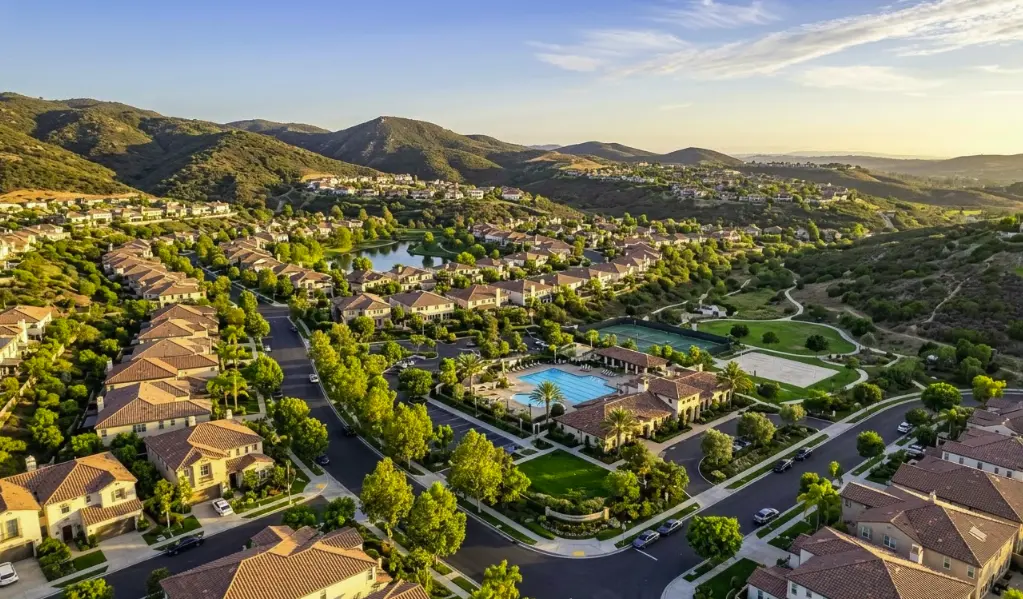
San Marcos Property Management: 2026 Guide for Rental Owners
By Scott Engle, Broker/Owner — Realty Management Group | DRE #01332676 | Corp DRE #02075336 | Last Updated: July 2026
What is San Marcos property management?
San Marcos property management is a compliance-driven asset management system where legal timing, pricing accuracy, and maintenance execution directly determine rental income and long-term property value. San Marcos, California — located in North County San Diego — operates under California statewide rental law with no local rent control ordinance, a high concentration of HOA-governed master-planned communities, and a structurally diverse tenant base spanning university students, healthcare professionals, and families.
Most landlord losses in this market are not caused by bad tenants. They are caused by missed notices, HOA violations, under-priced vacancies, and preventable maintenance events that compound quietly until they appear as a valuation problem.
For a direct cost comparison between percentage-based and flat-fee structures, see: How Much San Diego Property Managers Actually Cost: Flat Fee vs 8% Management Explained.
TL;DR
- San Marcos property management is a compliance-driven asset management system — not a rent collection service.
- Median rent $2,545–$3,200/month (March 2026). ZIP 92069 ~$3,188; ZIP 92078 ~$3,164. Rents up 8% year-over-year.
- Most San Marcos landlords lose more money from one vacancy event than an entire year of management fees.
- A single mismanaged vacancy event erases $79,000–$104,000 in property value at a 5.2% cap rate.
- Compliance mistakes are not fixable after the fact — in most cases they convert into permanent financial limitations.
- Failing to serve the AB 1482 exemption notice in most cases permanently subjects the tenancy to rent cap protections.
- Without AB 2801-compliant photos, 100% of your deposit deductions are legally indefensible.
- HOA rules in master-planned communities create compliance obligations most self-managing landlords miss entirely.
- California's 2026 laws — AB 628, AB 2801, AB 2747 — apply to any lease signed or renewed this year.
- Flat-fee management at $199/month — no percentage of rent, no leasing fee.
Quick Answers
What is the average rent in San Marcos in 2026?
The citywide median rent is approximately $2,545/month (Redfin, March 2026), with Zumper reporting a broader median of $3,200 across all unit types. By bedroom: 1BRs ~$1,925–$2,659; 2BRs ~$2,375–$3,276; 3BRs ~$3,400+. ZIP 92069 and 92078 are closely priced at approximately $3,164–$3,188.
Is San Marcos a good rental market in 2026?
Yes. Rents are up 8% year-over-year and increased 2% last month — stronger growth than most San Diego County submarkets. A 96% occupancy rate and consistent demand from CSUSM students, Palomar College faculty, Palomar Medical Center staff, and North County tech and manufacturing professionals keeps vacancy structurally low.
Does San Marcos have rent control?
No. San Marcos has no local rent control ordinance. California's AB 1482 caps annual increases at 5% + local CPI (max 10%) for covered units. Single-family homes and condos may be exempt — but only with a properly served written exemption notice. Without that notice, the exemption does not exist. See: California Rent Control: What San Diego Landlords Must Know.
What makes San Marcos management more complex than other North County cities?
Three factors: HOA-heavy master-planned communities with rental restrictions and move-in procedures; a mixed tenant base spanning students, families, and professionals; and California's 2026 compliance layer that changes lease requirements for any renewal signed this year. See: What San Diego Property Owners Must Track to Stay Compliant.
What is the RMG NOI Protection Model?
The RMG NOI Protection Model is a five-system operational framework — covering Pricing, Compliance, HOA Integration, Maintenance, and Documentation — designed to protect San Marcos rental property Net Operating Income and long-term asset value through documented, repeatable processes rather than reactive management decisions.
San Marcos Rental Market Data — 2026
San Marcos ZIP Code Overview — March 2026
| ZIP | Area | Avg Rent | Primary Demand | Best Unit Type |
|---|---|---|---|---|
| 92069 | Central / CSUSM corridor / Downtown | ~$3,188 | Students, professionals, healthcare | 1BR–2BR apartments |
| 92078 | San Elijo Hills / Twin Oaks / West | ~$3,164 | Families, professionals, retirees | 2BR–4BR single-family / townhomes |
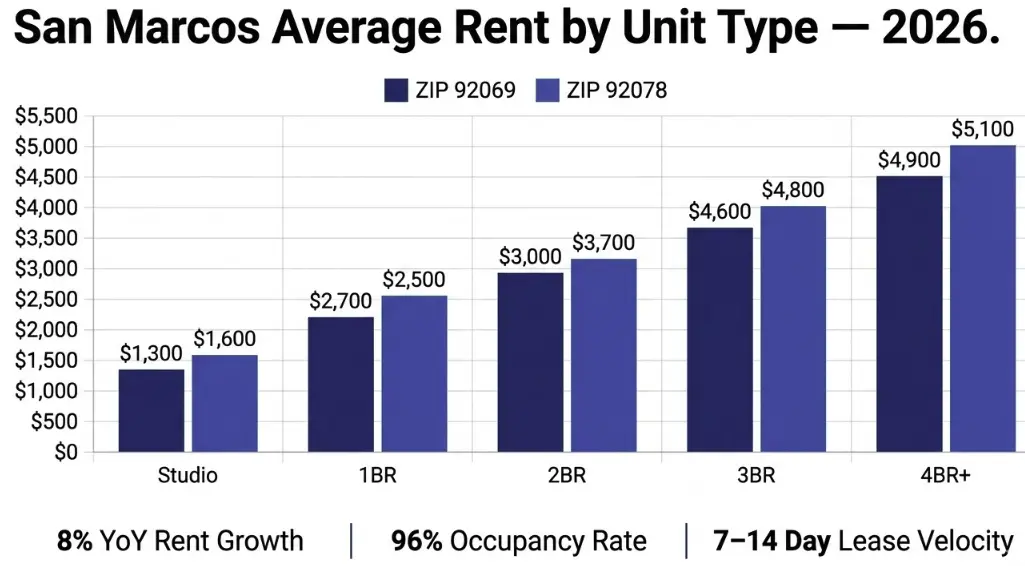 Average rents by unit type, San Marcos CA — March 2026. Sources: Zumper, Redfin, Apartments.com.
Average Rents by Unit Type — San Marcos 2026. Sources: Zumper, Rent.com, Apartments.com. Ranges reflect condition and submarket.
| Unit Type | Avg Rent (2026) | YoY Trend | Notes |
|---|---|---|---|
| Studio | ~$2,609 | Stable | Richmar and Village O most affordable |
| 1 Bedroom | ~$1,925–$2,659 | +8% YoY | CSUSM corridor lower; San Elijo Hills higher |
| 2 Bedroom | ~$2,375–$3,276 | Resilient | Most in-demand unit type across both ZIPs |
| 3 Bedroom | ~$3,400+ | Strong | San Elijo Hills family demand; tight supply |
| 4+ Bedroom | ~$4,200–$5,500+ | Limited data | Twin Oaks Valley equestrian/luxury segment |
San Marcos's 8% year-over-year rent growth makes it one of the stronger performing North County submarkets in 2026. The demand pipeline — CSUSM enrollment, Palomar Medical Center employment, and North City business park expansion — provides structural support that coastal markets don't always have. Vacancy sits at approximately 4%. Well-priced properties in both ZIPs typically lease within 7–14 days. See: Top San Diego Neighborhoods Poised for Rent Growth in 2026.
The Irreversible Mistakes San Marcos Landlords Make
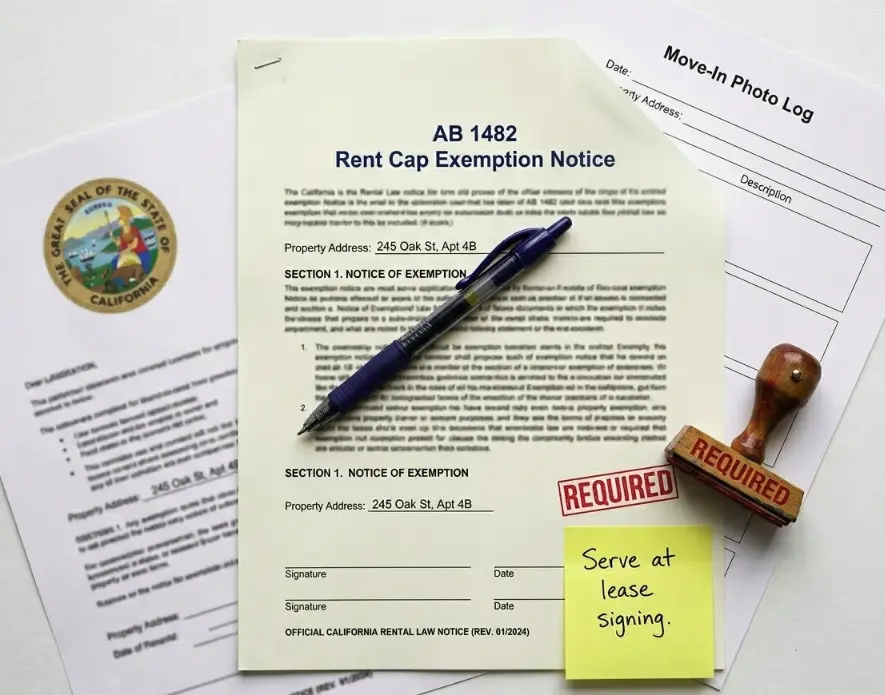 Three California compliance failures cannot be corrected after the fact. The AB 1482 exemption notice is the most financially consequential document in residential property management.
❌ AB 1482 Exemption Notice Never Served
If you own a qualifying single-family home or condo and have not served the written AB 1482 exemption notice, in most cases this permanently subjects that tenancy to rent cap protections with no practical retroactive cure. You cannot serve it late and restore the exemption. This is the most financially consequential document in California residential property management and the most commonly missing item in San Marcos rental files. See: California Rent Control: What San Diego Landlords Must Know.
❌ AB 2801 Photos Missing at Move-In
Without timestamped photos taken before tenant occupancy, 100% of your security deposit deductions are legally indefensible — regardless of actual property condition. The photos are not supporting evidence. They are the legal prerequisite for making any deduction at all. See: Security Deposits in San Diego County — Rules, Deadlines & Tenant Rights.
❌ Mispriced Listing Left on Market Past Day 14
A vacancy sitting for three weeks doesn't just cost three weeks of rent — it resets your demand curve. Qualified renters apply in the first ten days or move on. What remains after day 14 is a degraded applicant pool. The cost is not just lost income; it is the quality of who you end up placing. See: 7 Warning Signs of Bad Property Management: How San Diego Owners Get Stuck.
What Does Bad Management Actually Cost? — The RMG NOI Protection Model
Most San Marcos landlords think about management cost as a monthly fee. That framing understates actual financial exposure by a factor of ten or more. At a 5.2% cap rate — the current San Diego County investment standard — every dollar of annual NOI lost translates to $19.23 in lost property value.
Model 1 — 3BR San Marcos Rental at $3,400/month
| 3 weeks preventable vacancy | $2,550 |
| Leasing fee at ½ month (percentage model) | $1,700 |
| Turn repairs from deferred maintenance | $1,200 |
| Total single event cost | $5,450 |
$5,450 ÷ 0.052 = $104,807 in lost property value from one avoidable event
Model 2 — 2BR San Marcos Rental at $2,600/month
| 3 weeks preventable vacancy | $1,950 |
| Leasing fee at ½ month (percentage model) | $1,300 |
| Turn repairs from deferred maintenance | $900 |
| Total single event cost | $4,150 |
$4,150 ÷ 0.052 = $79,807 in lost property value
The 2BR is the most common unit type in San Marcos. Run either event twice in three years and cumulative valuation damage exceeds $150,000–$200,000. This is not a management fee discussion. This is a property valuation discussion.
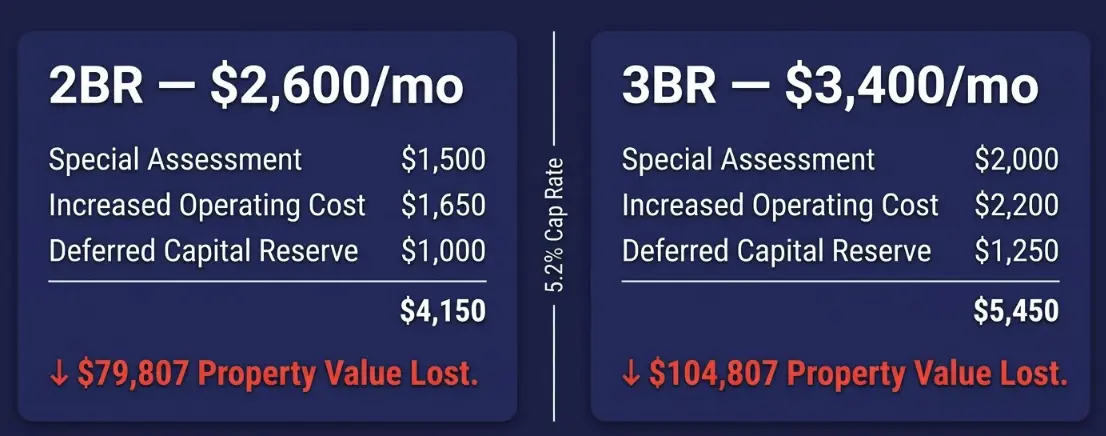 At a 5.2% cap rate, a single mismanaged vacancy event erodes $79,000–$104,000 in San Marcos property value. Management cost is a valuation question, not a monthly fee question.
Maintenance Arbitrage: The Hidden Profit Lever
Maintenance Arbitrage Example — San Marcos 2026
| Action | Cost | Value Impact at 5.2% Cap |
|---|---|---|
| Preventative HVAC service | $475 | — |
| Emergency replacement avoided | $3,800 saved | — |
| Net saving | $3,325 | $63,942 preserved |
Every maintenance request we receive is logged, triaged, and resolved within our 48-hour documentation standard. Every repair decision is evaluated against its Maintenance Arbitrage impact before dispatch. Anything outside that window is operational negligence — and that is where liability starts.
Transactional vs. Asset-Based Property Management in San Marcos
| Operational Area | Transactional Management | Asset-Based Management (RMG) |
|---|---|---|
| Rent Setting | Set once at vacancy, adjusted reactively | Live comps + velocity tracking at every renewal |
| Maintenance | Reactive — respond when tenant calls | Maintenance Arbitrage — preventative spend vs. replacement cost |
| Compliance | Follow deadlines when reminded | Pre-calendared — AB laws, HOA notices tracked in advance |
| HOA | Respond to violation notices | Addendum-first — violations prevented through lease alignment |
| Performance Metric | Monthly fee collected | NOI and long-term asset valuation |
| Documentation | Available if requested | Audit-ready on every property, every month |
| Vacancy | Fill as quickly as possible | Price correctly day one; retain qualified tenants |
| Cost Structure | 8–10% of rent + leasing fee | Flat $199/month, no leasing fee |
The RMG NOI Protection Model — Five System Stack
System 1: Pricing System
Every rental analysis uses live San Marcos comps at the ZIP level across 92069 and 92078, combined with vacancy velocity tracking. Rent is reviewed at every renewal against live data — not last year's number.
System 2: Compliance System
Every AB law deadline, notice requirement, and lease renewal is tracked in advance. AB 1482 exemption notices are served at lease inception for every qualifying property. AB 2801 photo documentation is executed at every move-in and move-out without exception.
System 3: HOA Integration System
Every San Marcos property in an HOA community receives a lease addendum prepared to that HOA's current rules. Move-in procedures, parking, pet policy, and exterior standards are communicated to tenants at lease signing — not after the first violation.
System 4: Maintenance System
Every maintenance request is logged within 24 hours, triaged by urgency and Maintenance Arbitrage impact, and dispatched within our 48-hour documentation standard. Every repair decision is evaluated for its NOI impact — not just its immediate cost.
System 5: Documentation System
Every action — every notice served, every maintenance event, every lease modification, every HOA communication — is documented in an audit-ready format. Timestamped, attributed, retrievable. If a dispute arises, the documentation exists. If you need to switch managers, the file transfers cleanly. See: What Owners Should Expect From Monthly Property Management Reports.
When Is Your San Marcos Rental Mispriced? — The Vacancy Decision Rule
Vacancy Decision Rule — Use These Thresholds Without Exception:
- Fewer than 5 qualified inquiries in 7 days → overpriced for current submarket. Reduce now. Do not wait for week two.
- Zero applications after 10 days of active showings → overpriced by 5–8%. A $150–$200/month reduction costs $1,800–$2,400 annually. Three additional weeks of vacancy on a $3,000 property costs $2,400 plus applicant pool degradation. The reduction is always the better financial decision.
- Still vacant at day 21 → you have lost $2,300–$2,800, your momentum has reset, and the remaining applicant pool skews toward higher-risk profiles. Reduce price and re-launch marketing from the beginning.
Qualified renters — stable income, strong credit, long prior tenancy — apply in the first ten days or they move on. Everything after day 14 is a different market.
HOA Management in San Marcos: What Landlords Need to Know
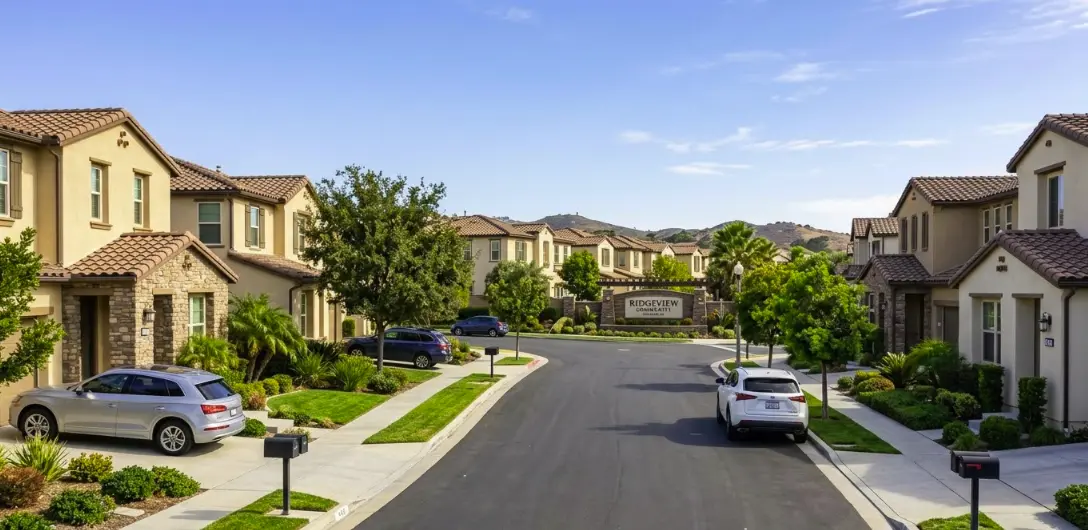 San Marcos has a higher concentration of HOA-governed properties than most San Diego County cities. HOA fines go to the owner — not the tenant — without a compliant lease addendum. Master-planned communities including San Elijo Hills, Creekside, Discovery Hills, and Twin Oaks Valley all operate under HOA rules that directly affect how rental properties can be managed. See: What San Diego Property Owners Must Track to Stay Compliant.
The Five HOA Issues That Create the Most Owner Liability
Rental caps and registration requirements. Some San Marcos HOAs limit the percentage of units that can be rented at any time. If you purchased in a capped community, you may be on a waitlist before you can legally rent. Verify rental eligibility before listing — not after.
Move-in and move-out procedures. Many HOAs require advance notice, designated moving hours, elevator reservations, and a separate HOA damage deposit. Missing these triggers fines that go to you, not the tenant.
Lease addendum requirements. HOAs frequently require tenants to acknowledge and sign HOA rules as part of their lease. Without this addendum, HOA violations by the tenant are unenforceable against them — and the fine remains with you.
Parking, pet, and exterior restrictions. HOA rules are frequently stricter than state law. If your lease does not reflect these restrictions, you cannot enforce them.
Violation notices and fines. When a tenant violates HOA rules, the fine goes to the owner — not the tenant — unless your lease explicitly passes liability through with a compliant addendum.
For San Marcos short-term rental owners: San Marcos Short-Term Rental Permits & Zoning Guide: A 2026 Investor Playbook.
2026 California Compliance Requirements San Marcos Landlords Must Know
| Law | Requirement | Consequence of Non-Compliance |
|---|---|---|
| AB 1482 Rent Cap | Annual increases capped at 5% + local CPI (max 10%) for covered units. | In most cases, failing to serve the exemption notice permanently subjects that tenancy to rent cap protections with no practical retroactive cure. |
| AB 628 Appliances eff. Jan 1, 2026 | Leases signed, renewed, or amended on/after Jan 1, 2026 must include a working stove and refrigerator. | A renewal without this provision creates an immediate habitability deficiency. Tenants may use it as a defense against rent enforcement. |
| AB 2801 Move-In/Out Photos | Timestamped photos required before tenant occupancy and after move-out. | Without compliant documentation, 100% of deposit deductions are legally indefensible. The photos are not supporting evidence — they are the legal prerequisite for making any deduction. |
| AB 2747 Rent Reporting | Landlords must offer tenants the option to report rent payments to credit bureaus at lease signing and annually. | Creates ongoing documentation obligation. Failure generates legal exposure that compounds if other disputes arise. |
| AB 12 Deposit Cap eff. Jul 1, 2024 | Maximum security deposit of one month's rent (furnished or unfurnished) for most landlords. | Collecting more than one month exposes owners to return of excess plus statutory damages. If your lease still says "two months," update it immediately. |
| AB 2493 Application Fees eff. Jan 2025 | Sequential processing or refundable fee structures required. | Simultaneous applications with non-refundable fees are out of compliance. See: California AB 2493 Explained. |
San Marcos Late Fee and 3-Day Notice Rules
Late fees must be grounded in lease language, and 3-day notices must cite the correct legally delinquent amount. A single drafting error in your lease's late-fee clause can void your 3-day notice entirely — forcing you to restart the statutory timeline from zero. See: San Marcos Late Fees and Notice Timing: The Lease Language That Makes Your 3-Day Notice Void.
The most common compliance failures we find in San Marcos rental files:
- AB 1482 exemption notice never served on qualifying single-family homes and condos
- Rent increase notices issued inside the required advance window — voiding the increase
- HOA lease addendum missing — tenant violations become unenforceable owner liability
- Move-in photos not timestamped per AB 2801 — deposit deductions legally indefensible
- Security deposits exceeding one month's rent under AB 12
- AB 2747 rent reporting option not offered at lease signing
- AB 628 appliance requirement absent from 2026 lease renewals
- Late fee language insufficient to support a valid 3-day notice
San Marcos Neighborhoods: What Landlords Need to Know in 2026
San Elijo Hills (92078)
The most desirable family rental submarket in San Marcos. 3BR and 4BR homes lease quickly and retain tenants longer than any other neighborhood. HOA compliance is non-negotiable here — the San Elijo Hills HOA actively enforces rules and issues fines. Every tenancy requires a lease addendum, documented move-in procedure, and pre-move-in HOA registration.
Discovery Hills (92069)
Closest neighborhood to CSUSM. Consistent demand but higher turnover than family neighborhoods. Income verification, guarantor documentation for students, and roommate lease structures are standard. Notice timing is more frequently contested here than anywhere else in San Marcos — lease language must be precise. See: San Marcos Late Fees and Notice Timing.
Twin Oaks Valley (92078)
Equestrian-friendly, spacious, higher price points. Exceptional performance for well-maintained larger homes. Maintenance Arbitrage ROI is highest in this submarket — deferred maintenance on larger properties compounds faster than anywhere else in the city.
Lake San Marcos (92078)
Resort-style, retirement-adjacent community. Lower turnover, longer average tenancy, stable income profiles. Responsive maintenance is the primary driver of retention here — not price.
North City / Creekside (92069)
Emerging mixed-use corridor near the 78 freeway. Strong appeal for young professionals in Carlsbad, Vista, and the North County tech corridor. This is the submarket most likely to see continued rent appreciation as North City employment density increases.
Richmar and Village O (92069)
Most affordable neighborhoods in San Marcos. Consistent demand from cost-sensitive renters. Good investor entry point with lower HOA complexity than master-planned communities. Strong 1BR demand with reliable leasing velocity.
Why San Marcos Landlords Use Professional Property Management
At Realty Management Group, we manage San Marcos rentals for a flat $199/month — no percentage of rent, no leasing fee, no hidden charges. On a $3,000/month rental, most San Diego property managers charge $240–$300/month (8–10%) plus a leasing fee of up to one month's rent at every turnover. Our flat fee stays the same as your rent increases. At a 5.2% cap rate, the $1,992 annual difference between a flat $199/month fee and an 8% model on a $3,000 rental represents $38,307 in long-term property value.
Full cost comparison: How Much San Diego Property Managers Actually Cost: Flat Fee vs 8% Management Explained.
What we handle for San Marcos owners:
- Data-backed rent pricing using live San Marcos comps across 92069 and 92078 — free rental analysis
- Professional marketing: photographs, multi-platform listings on Zillow, Apartments.com, and Realtor.com — our marketing process
- Comprehensive tenant screening: credit, income, background, prior landlord verification, eviction history — our screening standards
- HOA compliance coordination: lease addendum preparation, move-in procedure management, violation response, and ongoing HOA communication on your behalf
- Rent collection with structured enforcement and lease-grounded late-fee application — our rent collection process
- Maintenance coordination 24/7 with Maintenance Arbitrage logic applied to every repair decision — our maintenance services
- Full California compliance: AB 1482, AB 628, AB 2801, AB 2747, AB 12, AB 2493, and San Marcos-specific notice and late-fee requirements
- Monthly owner statements and tax-ready documentation — our financial reporting
We guarantee a qualified tenant within 30 days — or your first month of management is free. We cover eviction filing costs for approved tenants within the first 12 months. See: all our guarantees.
If you are currently dealing with delayed maintenance responses, missed compliance deadlines, or poor communication from your current management company, here is exactly how to switch property managers without losing tenants or disrupting your rent cycle. Also see: What Happens to Your Tenant When You Change Property Managers.
Key Takeaways
- San Marcos property management is a compliance-driven asset management system. Rent collection is the outcome, not the service.
- Rents are up 8% year-over-year. Under-pricing is a larger risk than vacancy in most San Marcos submarkets right now.
- Most San Marcos landlords lose more money from one vacancy event than an entire year of management fees.
- A single mismanaged vacancy event destroys $79,000–$104,000 in property value at a 5.2% cap rate. Run it twice in three years and cumulative damage exceeds $150,000.
- A $475 preventative maintenance decision preserves $63,942 in asset value at the same cap rate.
- In most cases, failing to serve the AB 1482 exemption notice permanently subjects the tenancy to rent cap protections with no practical retroactive cure.
- Without AB 2801-compliant timestamped photos, 100% of deposit deductions are legally indefensible.
- HOA compliance is the most operationally complex element of San Marcos property management and the most commonly missed by self-managing landlords.
- Every decision in San Marcos property management either increases your asset value or erodes it. Most landlords don't realize which one is happening until it's already reflected in their numbers.
Frequently Asked Questions — San Marcos Property Management
What is the average rent in San Marcos in 2026?
The citywide median rent is approximately $2,545/month (Redfin) to $3,200/month (Zumper) depending on methodology. By bedroom: studios ~$2,609; 1BRs ~$1,925–$2,659; 2BRs ~$2,375–$3,276; 3BRs ~$3,400+. ZIP 92069 averages ~$3,188 and ZIP 92078 averages ~$3,164.
Is San Marcos subject to rent control?
No. San Marcos has no local rent control ordinance. California AB 1482 caps annual increases at 5% + local CPI (max 10%) for covered properties. Single-family homes and condos may qualify for an exemption — but only with a properly served written notice. Without that notice, in most cases the cap applies permanently. See: California Rent Control: What San Diego Landlords Must Know.
What does a single vacancy event actually cost in San Marcos?
On a 3BR at $3,400/month: approximately $5,450 in combined vacancy loss, leasing fees, and turn costs. At a 5.2% cap rate, that single event reduces property value by over $104,000. On a 2BR at $2,600/month: approximately $4,150, reducing property value by approximately $79,800. Retention is the primary financial lever available to San Marcos landlords.
How does HOA management work for San Marcos rentals?
The owner remains responsible to the HOA for all tenant behavior and rule compliance. HOA fines go to the owner — not the tenant — unless your lease includes a compliant addendum that passes liability through. If cumulative HOA fines on a tenancy exceed one month's rent, evaluate re-leasing to a compliant tenant.
How long does it take to rent a property in San Marcos?
Well-priced, well-presented properties lease in 7–14 days. Fewer than 5 qualified inquiries in the first 7 days indicates overpricing. Zero applications after 10 days means overpriced by 5–8%. At day 21 still vacant, you have lost $2,300–$2,800 and your applicant pool has degraded significantly.
What does AB 628 require for San Marcos rentals in 2026?
AB 628, effective January 1, 2026, requires landlords to provide a working stove and refrigerator for most residential leases signed, renewed, or amended on or after that date. A renewal without this provision creates an immediate habitability deficiency that tenants can use as a legal defense against rent enforcement.
How much does property management cost in San Marcos?
Most San Marcos property managers charge 8–10% of collected rent plus a leasing fee. On a $3,000/month rental: $2,880–$3,600/year in fees alone, plus up to $3,000 at each turnover. Realty Management Group charges a flat $199/month regardless of rent. At a 5.2% cap rate, the annual fee structure difference represents over $38,000 in long-term property value. See: our pricing page.
What is the San Marcos short-term rental permit process in 2026?
San Marcos STRs are regulated through zoning authorization and business licensing. STR operation in most residential zones requires city approval and 10% Transient Occupancy Tax compliance. SB 346, effective January 1, 2026, allows the city to compel platforms to report listing data. Full guide: San Marcos Short-Term Rental Permits & Zoning Guide.
What is the RMG NOI Protection Model?
The RMG NOI Protection Model is a five-system operational framework covering Pricing, Compliance, HOA Integration, Maintenance, and Documentation — designed to protect San Marcos rental property Net Operating Income and long-term asset value through documented, repeatable processes. Each system operates to the same standard on every property, every month.
Summary
San Marcos is a structurally strong rental market with above-average rent growth, consistent multi-segment demand, and tight supply that supports continued NOI performance in 2026. The challenge is not the market. It is the compliance and operational layer — HOA obligations, California's 2026 law changes, lease-language precision on notices and late fees, and the documented maintenance system required to protect asset value over time.
Most San Marcos landlords don't lose money on bad tenants. They lose it on operational inefficiency that compounds across vacancy events, compliance failures, and deferred maintenance until it shows up as a valuation problem.
Every decision in San Marcos property management either increases your asset value or erodes it. Most landlords don't realize which one is happening until it's already reflected in their numbers.
Talk to a San Marcos Property Management Specialist
Realty Management Group has managed San Marcos rental properties since 2005. We know the submarkets, the HOA rules, the compliance requirements, and the tenant pool. Whether you're considering professional management for the first time or switching from your current company, we make the process straightforward.
📞 (619) 456-0000 📧 info@choosermg.com
Request a Free San Marcos Rental Analysis →Related Resources for San Marcos Rental Owners
- San Marcos Property Management Services — Realty Management Group
- San Marcos Short-Term Rental Permits & Zoning Guide: A 2026 Investor Playbook
- San Marcos Late Fees and Notice Timing: The Lease Language That Makes Your 3-Day Notice Void
- How Much San Diego Property Managers Actually Cost: Flat Fee vs 8% Explained
- Chula Vista Landlord Laws & Rental Regulations (2026 Guide)
- Security Deposits in San Diego County — Rules, Deadlines & Tenant Rights
- How to Switch Property Managers Without Losing Tenants (California Guide)