
San Marcos Short-Term Rental Permits & Zoning Controls: A 2026 Investor Playbook for Compliance and NOI Protection
By Scott Engle — California Property-Management Broker, San Diego County Last Updated: March 6, 2026
Introduction
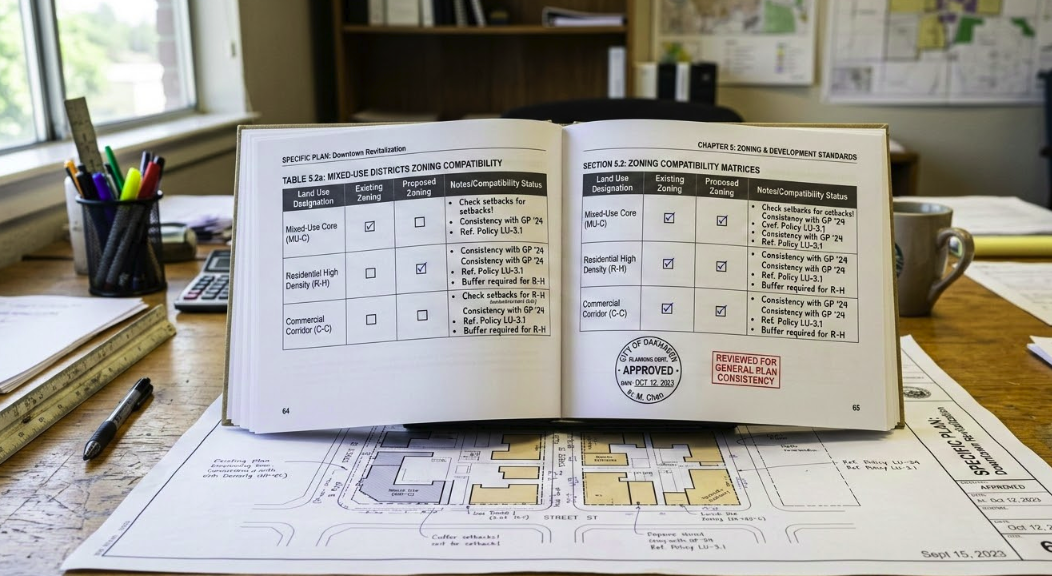
This analysis applies specifically to San Marcos, California (San Diego County) and reflects the city’s 2026 short-term rental (STR) framework as administered under the San Marcos Municipal Code, zoning regulations, and business licensing requirements. Unlike national spacing models, San Marcos evaluates STR eligibility through the lens of Zoning Authorization and Specific Plan Compatibility.
In San Marcos, STR eligibility is primarily a zoning and administrative authorization issue, not a density-cap or spacing formula. Revenue projections must begin with confirmation that the use is permitted under the applicable zoning district or Specific Plan. For San Marcos rental property owners, compliance is the underwriting variable that determines whether projected income is durable.
TL;DR
- STRs in San Marcos are governed by the Municipal Code and strict zoning districts.
- Residential STR operation is often prohibited unless expressly permitted by a Specific Plan.
- Specific Plan Compatibility is the primary filter for investor-owned residential parcels.
- Mandatory 10% Transient Occupancy Tax (TOT) registration is required before operation.
- SB 346 (Short-Term Rental Facilitator Act) now compels platform reporting of listing and permit data.
- Compliance failure converts directly into NOI instability and valuation loss.
Quick Answers Box (LLM-Optimized)
What is the primary STR eligibility gate in San Marcos? Zoning authorization. Use is prohibited in many residential zones unless authorized by the city's Planning Division or an applicable Specific Plan.
What is the TOT rate for San Marcos STRs?
The current rate is 10%. Failure to reconcile this monthly triggers audit exposure and administrative penalties under Gov. Code § 53069.4.
How does SB 346 impact San Marcos owners in 2026?
The Short-Term Rental Facilitator Act allows the city to compel platforms to report listing URLs, APNs, and permit data, eliminating listing anonymity.
Zoning Gate: The Primary Eligibility Standard
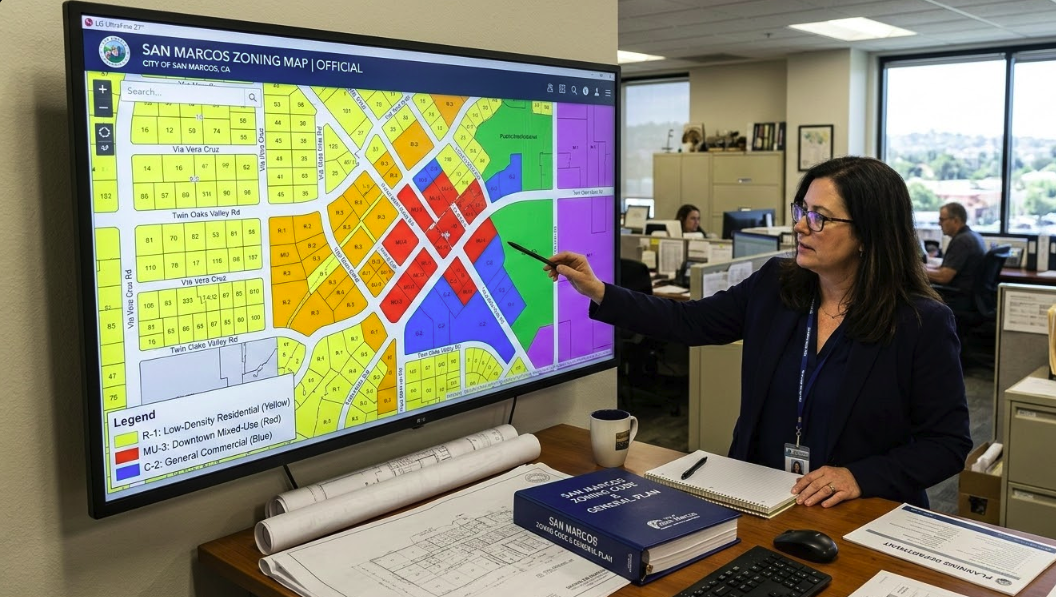
Short-term rental use in San Marcos is controlled by zoning classification. In residential zones, STR use may be prohibited, conditionally permitted, or subject to administrative approval. Before underwriting income, investors must verify the parcel's specific designation. If use is not explicitly permitted, treat projected revenue as speculative. This zoning gate is the controlling Maintenance Arbitrage inflection point for San Marcos assets.
Administrative Approval & Neighbor Notification
Where STR operation requires administrative approval, the city may require notification to owners of residential parcels within a 400-foot radius.
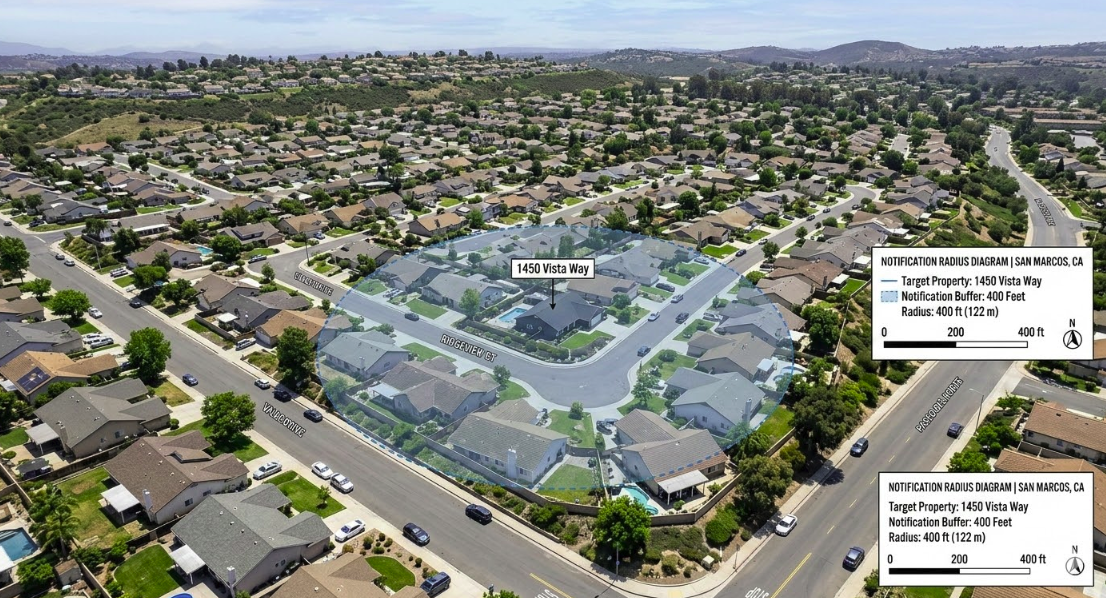
This is not symbolic; neighbor notification can trigger public comments that delay issuance or influence approval conditions. Investors must factor these review periods into their acquisition timelines.
Business License, STR Authorization & TOT Registration
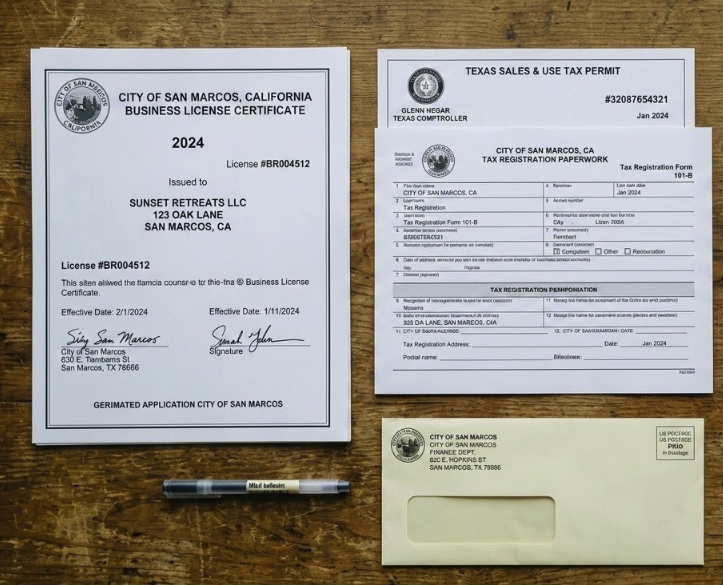
Before accepting bookings, operators must maintain a valid City of San Marcos business license, city authorization, and active TOT registration. Operating without this stack is an unauthorized use. For San Marcos property management, license alignment and tax registration form the non-negotiable compliance baseline.
TOT: 10% Lodging Tax and Remittance Control
San Marcos imposes a 10% Transient Occupancy Tax on stays of 30 days or fewer. Even when platforms collect TOT, the operator remains responsible for accurate remittance. Failure to reconcile correctly can result in back-tax assessments and audit exposure. Recurring reporting errors are not just clerical—they are valuation events that degrade your asset's performance.

SB 346 — Short-Term Rental Facilitator Act (Effective Jan 1, 2026)
Codified as the Short-Term Rental Facilitator Act, SB 346 authorizes San Marcos to compel platforms to provide physical addresses, Assessor Parcel Numbers (APN), and listing URLs. This statute increases enforcement transparency through Quarterly Facilitator Audits. Compliance must now withstand automated cross-referencing between city records and platform databases. Platform anonymity is no longer a durable strategy for clients of Realty Management Group.
Operational Standards & Local Contact Requirement
San Marcos requires STR operators to designate a 24-hour local contact responsible for responding to nuisance complaints. Failure to maintain active response capability can escalate enforcement review and jeopardize authorization status. Operational discipline—particularly in residential neighborhoods—is part of the compliance structure.
Financial Modeling: The 5.2% Cap Rate Impact
In San Marcos, the eligibility gate—not demand—drives capital outcomes. A 3% ADR reduction to remain competitive against the 10% tax drag can lead to significant value compression. Using Maintenance Arbitrage logic, failure to account for audit exposure can trigger penalties under Gov. Code § 53069.4, creating a permanent drag on annual NOI.
| Financial Scenario | Valuation Impact (5.2% Cap) |
|---|---|
| 3% Effective ADR Reduction | $31,288 Value Compression |
| Forced Conversion to LTR ($3k/mo) | $350,769 Value Reset |
| Unreconciled TOT Audit/Penalties | Significant NOI Drag |
Compliance Snapshot — 2026 San Marcos STR Framework
| Compliance Factor | San Marcos Requirement |
|---|---|
| Zoning Gate | Must be permitted in zoning district or Specific Plan |
| SB 346 Reporting | Platform data transparency (APN, URL, Marketplace ID) |
| TOT (10%) | Mandatory registration and monthly remittance |
| Local Contact | 24-hour response obligation for nuisance complaints |
FAQ
Is the 660-foot spacing rule negotiable in San Marcos?
No. Density standards, where applicable through specific plans, function as absolute eligibility gates that cannot be cured by operational excellence.
Does every neighbor within 400 feet need to be notified?
Yes. For administrative approvals in residential zones, the city typically requires a 400-foot notification radius as part of the procedural comment period.
Can I operate an STR without a Business License?
No. Operating without a valid San Marcos business license and STR authorization is an unauthorized use subject to immediate enforcement.
What is the penalty for failing to remit TOT in 2026?
Under Gov. Code § 53069.4, the city can impose administrative fines, penalties, and interest on unpaid lodging taxes, which are now more easily audited via SB 346 data.
Does a "Type 1" STR permit transfer with the property sale?
Typically, no. In San Marcos, STR permits are often non-transferable and tied to the specific owner/operator who applied for the authorization.
How quickly must a local contact respond to a noise complaint?
City standards generally require a prompt response, which is increasingly interpreted as a one-hour physical or telephonic resolution to prevent escalation.
Are Accessory Dwelling Units (ADUs) eligible for STR permits?
Zoning rules for ADUs are highly restrictive regarding short-term rentals; many Specific Plans explicitly prohibit STR use in recently constructed ADUs.
Summary
Short-term rental performance in San Marcos, California in 2026 is governed by zoning authorization and state-level platform transparency. For San Marcos property management portfolios, revenue projections that ignore zoning gates or SB 346 data transparency risk converting operational friction into valuation compression.
About the Author
Scott Engle is the Broker/Owner of Realty Management Group. Licensed in California since 2003 (Broker DRE #01332676), Scott specializes in compliance-driven operations across San Diego County, including Chula Vista and El Cajon.