Updated August 2026 | Authored by Scott Engle, Broker DRE #01332676, Corp DRE #02075336 | Realty Management Group | Serving San Diego County Since 2005
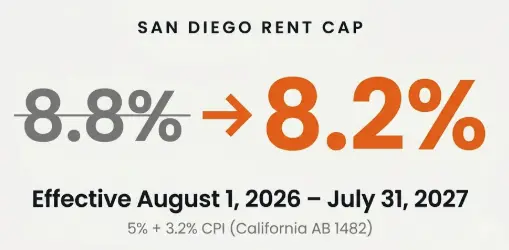
San Diego County's maximum allowable rent increase is 8.2% — effective August 1, 2026 through July 31, 2027. The figure is 5% plus the San Diego regional CPI change of 3.2%, under California AB 1482. It applies to every rent increase with an effective date in that window on a covered property. The date that governs is the effective date of the increase, not the date the notice was served.
This is the annual reset of California's statewide rent cap under the Tenant Protection Act (Civil Code §1947.12). The formula never changes — 5% plus regional CPI, never more than 10% — but the CPI input resets every August 1. For the 2025–26 window San Diego's CPI ran 3.8%, producing an 8.8% cap; for 2026–27 it came in at 3.2%, producing 8.2%.
This page covers the current number, the math at every common San Diego rent level, who is exempt, and the local-ordinance layer in three cities that the state form alone cannot satisfy. It is updated every August when the cap resets. For the notice-by-notice process, see the companion San Diego rent increase guide.
Quick Answers
What is the San Diego rent cap right now? 8.2% for increases effective August 1, 2026 through July 31, 2027, under California AB 1482 — calculated as 5% plus the San Diego regional CPI change of 3.2%. It replaced the 8.8% cap that applied to effective dates through July 31, 2026.
How do I calculate it? Multiply the current monthly rent by 0.082 and round down to the nearest dollar. On $2,800 that is $229, for a new rent of $3,029. If any increase was applied in the prior 12 months, subtract it — the combined total cannot exceed the cap.
Why did the cap go down? Local inflation cooled. The AB 1482 formula is fixed at 5% plus regional CPI, capped at 10%, and San Diego's CPI input fell from 3.8% to 3.2%.
Does the cap apply to my property? AB 1482 covers most San Diego County residential rentals more than 15 years old — a rolling threshold, currently properties built before January 1, 2011. Properties with a certificate of occupancy issued within the last 15 years are exempt. Single-family homes and condos not owned by a corporation, REIT, or corporate-member LLC are exempt only if the written exemption notice was properly included in the lease at signing.
How much notice is required? 30 days written notice for increases of 10% or less — which covers every lawful increase under the 8.2% cap — and 90 days for increases above 10% (Civil Code §827, possible only on exempt properties). Add 5 calendar days if mailed.
Do San Diego cities have their own rent caps? No city in San Diego County caps rent below the state 8.2% formula. But the City of San Diego, Chula Vista, and Imperial Beach have local tenant protection ordinances that add just-cause rules and notice requirements the state form alone does not satisfy. The cap is countywide; the paperwork is not.
The live mistake: applying last year's 8.8% to an increase taking effect now. The excess is unenforceable, the notice is disputable, and under Civil Code §1947.12 as amended by SB 567 a landlord who demands or retains rent above the cap can be liable to the tenant for the overcharge, attorney's fees, and — where the violation was willful or involved oppression, fraud, or malice — up to three times the amount of the overcharge.
TL;DR
- San Diego County's AB 1482 rent cap is 8.2% for increases effective August 1, 2026 – July 31, 2027
- Formula: 5% + San Diego regional CPI of 3.2%, verified against BLS CPI data
- Multiply rent by 0.082 and round down
- The effective date of the increase determines which cap applies — not the service date
- Two increases permitted per 12-month period, combined total capped at 8.2% of the rent in effect at the start of that period
- Notice: 30 days written; add 5 days if mailed; text and email are not valid service
- City of San Diego, Chula Vista, and Imperial Beach require city-specific ordinance compliance on top of the state form
- The cap resets again August 1, 2027 — this page is updated each August
San Diego Rent Cap: Key Numbers
Current maximum increase: 8.2% — effective dates August 1, 2026 through July 31, 2027
Prior cap: 8.8% — effective dates through July 31, 2026
Formula: 5% + regional CPI (3.2%), never to exceed 10% (Civil Code §1947.12)
CPI source: Bureau of Labor Statistics — the statute specifies April-to-April, with a March-to-March fallback where no April figure is published, which is the rule governing San Diego and Riverside Counties
Increases per 12 months: maximum 2, cumulative total capped at 8.2%
Notice: 30 days written; 90 days if an increase exceeds 10% (Civil Code §827, exempt properties only); +5 days if mailed
Coverage: most residential rentals more than 15 years old — currently those built before January 1, 2011 (rolling 15-year new-construction exemption)
Local ordinance cities: City of San Diego (SDMC §§98.0701–98.0709), Chula Vista (CVMC Ch. 9.65), Imperial Beach (IBMC Ch. 9.90)
Why the Cap Went Down
The AB 1482 cap is not a number the state picks — it is a calculation the state publishes inputs for. Every August 1 the allowable increase resets to 5% plus the change in the regional Consumer Price Index, with a hard ceiling of 10%. When local inflation falls, the cap falls with it.
Last cycle (Aug 1, 2025 – Jul 31, 2026): 5% + 3.8% CPI = 8.8%
Current cycle (Aug 1, 2026 – Jul 31, 2027): 5% + 3.2% CPI = 8.2%
The 10% ceiling: did not come into play. It only matters when regional CPI exceeds 5%.
A technical detail most summaries skip: the statute specifies the April-to-April CPI change, but where no April figure is published for the applicable area, the March-to-March change is used instead — and that fallback governs San Diego and Riverside Counties. It is also why California has no single statewide cap number. The 5% base is identical everywhere; each region's CPI sets its own total, so counties reset to different figures every August 1.
San Diego Rent Increase Calculator (8.2% Cap)
Enter your current monthly rent to calculate the maximum allowable increase for a covered property. Formula: Current Rent × 0.082, rounded down to the nearest dollar.
Current monthly rent ($):
Assumes AB 1482 coverage and one increase in the 12-month window. If you issued any increase in the past 12 months, the combined total cannot exceed the cap.
Overwhelmed by all the regulations?
We can take that off of your plate.
Free coverage check, exemption review, and your exact lawful maximum — before you serve anything · RMG manages 400+ units across San Diego County · 4.9★ from 127 Google reviews
Get 3 Months Free Call (619) 456-0000The 8.2% Cap by Rent Level
Maximum increase, new monthly rent, and added annual revenue for a covered property, assuming one increase in the 12-month window. Rounded down to the nearest dollar.
| Current rent | Max increase (8.2%) | New monthly rent | Added annual revenue |
|---|---|---|---|
| $1,800 | $147 | $1,947 | $1,764 |
| $2,000 | $164 | $2,164 | $1,968 |
| $2,200 | $180 | $2,380 | $2,160 |
| $2,400 | $196 | $2,596 | $2,352 |
| $2,600 | $213 | $2,813 | $2,556 |
| $2,800 | $229 | $3,029 | $2,748 |
| $3,000 | $246 | $3,246 | $2,952 |
| $3,200 | $262 | $3,462 | $3,144 |
| $3,500 | $287 | $3,787 | $3,444 |
| $3,800 | $311 | $4,111 | $3,732 |
| $4,200 | $344 | $4,544 | $4,128 |
| $4,800 | $393 | $5,193 | $4,716 |
| $5,500 | $451 | $5,951 | $5,412 |
For increases with effective dates August 1, 2026 through July 31, 2027 on AB 1482-covered properties. Two increases in the window are permitted, but the combined total cannot exceed Current Rent × 0.082.
If You Served a Notice at 8.8%
The controlling rule: the cap in effect on the increase's effective date governs, regardless of when the notice was served. That produces three situations.
Effective on or before July 31, 2026. Valid, assuming the notice itself was compliant. The increase took effect inside the 8.8% window.
Effective on or after August 1, 2026. The portion above 8.2% is unenforceable, even though 8.8% was the current cap when you served. The clean fix is to notify the tenant in writing of the corrected amount rather than attempt to collect the excess. Only the excess is invalid, not the entire increase — but a disputed notice is not worth 0.6%.
Two increases spanning the reset. The two-per-12-months rule follows the tenancy's own 12-month lookback, and the cumulative total is measured against the cap applicable to each increase's effective date. If you applied a partial increase in the spring under 8.8%, calculate the remaining headroom before assuming a second increase is available. This is the easiest place to accidentally exceed the cap.
Who the 8.2% Cap Does Not Apply To
Newer construction. Properties with a certificate of occupancy issued within the last 15 years are exempt. The exemption is rolling, currently covering buildings from 2011 onward.
Qualifying single-family homes and condos. Exempt only if the owner is not a corporation, REIT, or LLC with a corporate member, and the written AB 1482 exemption notice was properly included in the lease at signing. Miss the notice and the property is covered for that entire tenancy — it cannot be fixed retroactively.
Certain affordable and restricted housing. Deed-restricted and subsidized housing is typically exempt — verify with the administering agency.
The catch for exempt owners: exemption from the state cap is not exemption from everything. Notice-period rules still apply, anti-price-gouging limits apply during declared emergencies, and in the City of San Diego, Chula Vista, and Imperial Beach the local ordinance can still govern the tenancy even where the state cap does not.
For the complete coverage framework, see the AB 1482 exemptions guide.
Same Cap, Different Paperwork in Three Cities
No San Diego County city lowers the 8.2% cap — the number is countywide. What changes is the process. Three cities have local ordinances adding requirements the state form cannot satisfy, and a notice missing city-required compliance can be void even when the math is perfect.
City of San Diego — Residential Tenant Protections Ordinance (SDMC §§98.0701–98.0709): just cause from day one of tenancy; no-fault relocation of two months' rent, three if the tenant is 62 or older or disabled, paid within 15 days; notification to the San Diego Housing Commission for both at-fault and no-fault terminations. Neighborhoods inside city limits — North Park, South Park, Mission Valley, Pacific Beach, La Jolla and the rest — are all covered.
Chula Vista — CVMC Chapter 9.65: just cause and relocation requirements; the City must be notified within three business days of a no-fault termination notice or the notice is invalid; substantial remodel requires a minimum spend of $40 per square foot.
Imperial Beach — IBMC Chapter 9.90, effective March 22, 2025: just cause with a stricter substantial-remodel definition than state law; additional relocation at properties of 15 or more units; the owner must file a Mandatory Termination of Tenancy Form with the City within three business days of serving any termination notice.
Everywhere else in the county — El Cajon, La Mesa, Santee, National City, Escondido, Oceanside, Carlsbad, and all unincorporated areas — state AB 1482 governs alone and the state form is sufficient. Full detail in the San Diego rent control ordinance map.
Should You Take the Full 8.2%?
The cap is a ceiling, not a recommendation. The legally maximum increase and the financially optimal increase are often different numbers, because an increase that triggers a move-out costs more than it earns.
The turnover math. On a $2,800/month unit the full 8.2% adds $229/month — $2,748 a year. One month of vacancy costs $2,800, before make-ready and marketing. If a maximum increase pushes a reliable tenant out, the year's gain is gone in the first vacant month.
Where restraint wins. Reliable long-term tenants already near market rent, tenancies with unresolved maintenance items, and units competing against concession-heavy new supply. The full framework is in the rent increase guide.
How RMG approaches it. Across 400+ managed units, the renewal decision is priced unit by unit against real comps rather than defaulted to the ceiling. The result is an average tenancy of 39 months against a national norm around 27. A flat fee model with no leasing fee means we earn nothing extra when a tenant turns over — the incentive points the same direction as the owner's.
Price the specific unit, not the statute. The cap tells you what you may do; the comps tell you what you should.
Pricing a renewal wrong can cost you THOUSANDS.
We benchmark your rent against live comps, calculate your lawful maximum, and tell you honestly whether taking the ceiling is the better play for that unit.
Get 3 Months Free Call (619) 456-0000Frequently Asked Questions
What is the maximum rent increase in San Diego right now?
8.2% for rent increases effective August 1, 2026 through July 31, 2027, on AB 1482-covered San Diego County properties. For increases that took effect on or before July 31, 2026, the applicable cap was 8.8%.
How do you calculate an 8.2% rent increase?
Multiply the current monthly rent by 0.082 and round down to the nearest dollar. Example: $2,800 × 0.082 = $229.60, rounded down to $229, for a new rent of $3,029. If any increase was applied in the prior 12 months, subtract it — the combined total cannot exceed the cap.
How is the 8.2% San Diego rent cap calculated?
Under Civil Code §1947.12 the cap is 5% plus the change in the regional Consumer Price Index, with a maximum of 10%. San Diego's regional CPI change for this cycle was 3.2%, so the cap is 5% + 3.2% = 8.2%. The CPI figure comes from Bureau of Labor Statistics data, using the April-to-April change with a March-to-March fallback for the San Diego area.
How much is an 8.2% increase in dollars?
Multiply the current rent by 0.082 and round down. On $2,400/month it is $196; on $2,800/month it is $229; on $3,200/month it is $262; on $3,500/month it is $287. The full breakdown and the calculator are above.
I served a notice at 8.8% that takes effect after August 1. Is it valid?
The portion above 8.2% is not. The cap that governs is the one in effect on the increase's effective date, so an increase effective on or after August 1, 2026 is limited to 8.2% even if the notice was served while 8.8% was current. The practical fix is to correct the amount in writing rather than attempt to collect the excess.
Why is San Diego's cap different from other California counties?
Because the 5%-plus-CPI formula uses each region's own inflation data. The 5% base is identical statewide, but regional CPI varies, so counties reset to different caps every August 1 under the same law. San Diego's 3.2% CPI produced an 8.2% cap for this cycle.
Can I raise rent twice in one year under the 8.2% cap?
Yes — AB 1482 permits up to two increases in any 12-month period, but their combined total cannot exceed 8.2% of the rent in effect at the start of that period. The two increases are measured against that original rent, not compounded — so 4% followed by 4.2% is permitted, while 4.1% compounded on top of a prior 4.1% would exceed the cap. If part of the cap was used earlier in the tenancy's 12-month window, only the remaining headroom is available, not a fresh 8.2%.
Does the 8.2% cap apply to single-family homes in San Diego?
Only if the home is covered. A single-family home or condo not owned by a corporation, REIT, or corporate-member LLC is exempt from the state cap — but only when the written exemption notice was properly included in the lease at signing. Without the notice, the home is covered for that tenancy and the 8.2% cap applies.
What notice do I need to give for an 8.2% rent increase?
At least 30 days written notice before the effective date, delivered by personal service or first class mail (add 5 calendar days if mailed). Text and email are generally not valid service. In the City of San Diego, Chula Vista, and Imperial Beach, local ordinance requirements apply on top of the state form.
What happens if I raise rent above 8.2% on a covered property?
The excess above the cap is unenforceable and the tenant may refuse it. Under Civil Code §1947.12 as amended by SB 567, a landlord who demands, accepts, receives, or retains rent above the maximum is liable to the tenant for the overcharge and, at the court's discretion, reasonable attorney's fees. Where the owner acted willfully or with oppression, fraud, or malice, damages may run up to three times the amount of the overcharge. The Attorney General and local city attorney or county counsel may also seek injunctive relief. Only the amount above the cap is invalid, not the entire increase.
When does the San Diego rent cap change next?
August 1, 2027, when the next CPI figure resets the formula for the 2027–28 window. This page is updated each August with the current figure, and the cap can always be verified against BLS CPI data before serving a notice.
How We Verify These Figures
The cap figures on this page are calculated directly from the statutory formula in Civil Code §1947.12 using Bureau of Labor Statistics regional CPI data, and cross-checked against the county figures published by the Legal Aid Society of San Diego. Remedy provisions reflect Civil Code §1947.12 as amended by SB 567, effective April 1, 2024. Local ordinance citations are to the current municipal codes of the City of San Diego, Chula Vista, and Imperial Beach. This page is reviewed at each annual reset; the "Updated" date in the byline reflects the last verification.
Figures reflect California Civil Code §1947.12 and BLS regional CPI data as of August 2026, for the cap window of August 1, 2026 through July 31, 2027. The calculator is an informational tool for covered properties and does not account for prior increases in the 12-month window or exemption status. Coverage, exemptions, and local ordinance applicability are fact-specific. This guide is for informational purposes only and does not constitute legal advice; consult a qualified California landlord-tenant attorney before serving notices or relying on an exemption.
The number changed; the discipline didn't. The 8.2% cap is public, the formula is fixed, and the math takes thirty seconds. What separates owners who capture the increase from owners who end up in a dispute is everything around the number — the effective date, the coverage status, the delivery method, and the local ordinance requirements in three jurisdictions.
Know your cap window, verify your coverage, serve it correctly — and decide unit by unit whether the ceiling is actually the right number.
Related Articles
- How Much Can I Raise Rent in San Diego? Rent Increase Guide
- California AB 1482 Rent Control: Exemptions, Calculations, and the San Diego Cap
- Which San Diego Cities Have Rent Control? Ordinance Map
- San Diego Tenant Protection Ordinance: Just Cause and Relocation
- Chula Vista Landlord Laws & Rental Regulations
- 2026 California Rental Laws: What San Diego Landlords Need to Know