Published August 2026 | Data period: calendar year 2026 | Scott Engle, Broker DRE #01332676, Corp DRE #02075336 | Realty Management Group, San Diego County
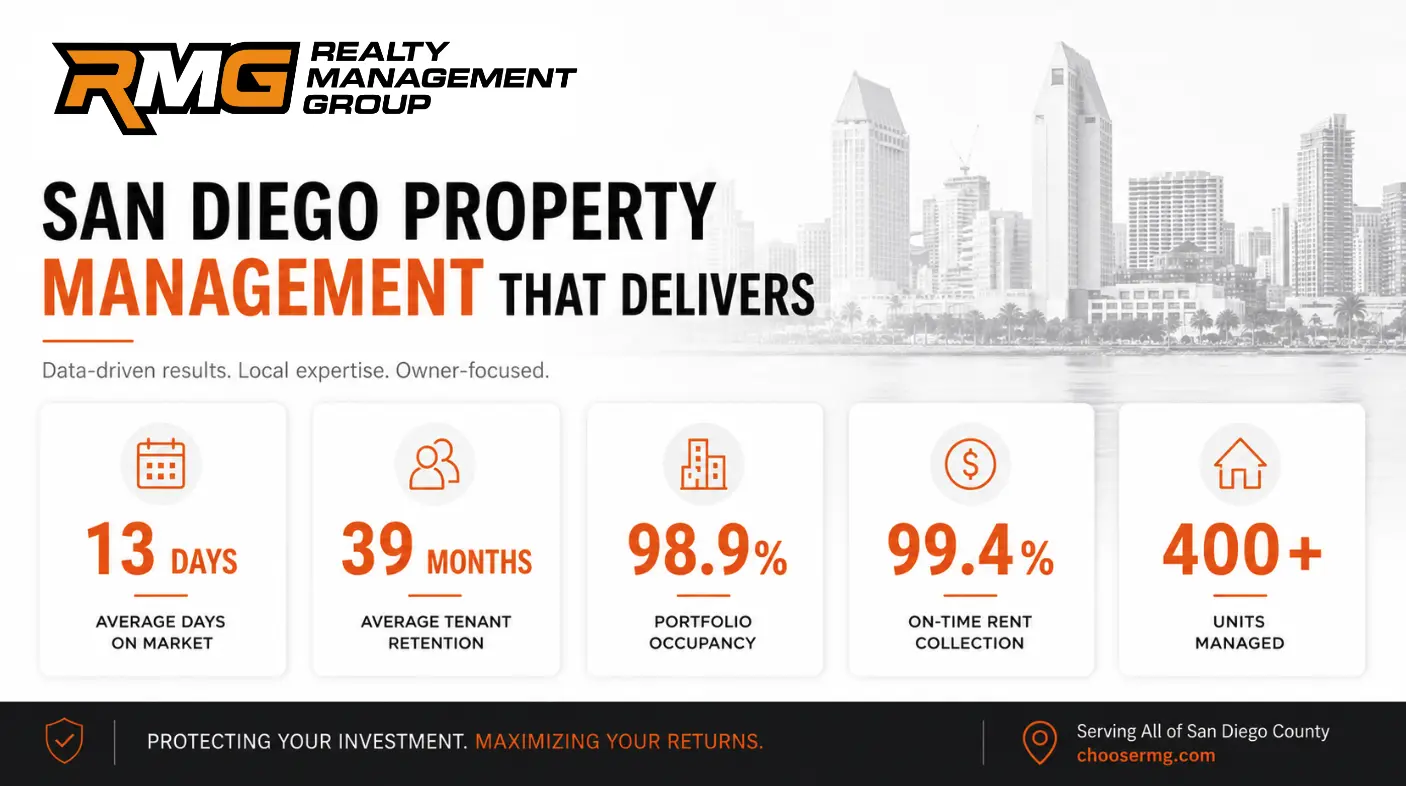
Realty Management Group manages 400+ residential rental units across San Diego County. This page publishes our actual operating results — how fast units lease, how long tenants stay, how reliably rent arrives — alongside the national benchmarks, so owners and researchers can compare real numbers instead of adjectives.
Most property management performance claims are unfalsifiable. "Fast leasing." "Great retention." "Responsive service." None of it can be checked. We publish the numbers instead, with the measurement method stated, so the claims can be evaluated rather than believed.
RMG operating data, 2026
| Units under management | 400+ across San Diego County |
| Average days to lease | 13 days |
| Average tenant retention | 39 months |
| Average owner retention | 48.6 months |
| Portfolio occupancy | 98.9% |
| On-time rent collection | 99.4% |
| Evictions since 2005 | Zero |
| Assets under management | $500M+ |
| Transactions completed | 1,000+ |
Source: Realty Management Group internal management data across all active managed residential units in San Diego County, 2026. Figures are a point-in-time snapshot and will move with the market.
RMG vs. Industry Benchmarks
| Metric | RMG (2026) | Industry benchmark |
|---|---|---|
| Days to lease | 13 days | 30–41 days |
| Average tenancy | 39 months | ~27 months |
| Occupancy | 98.9% | ~93–94% |
| On-time rent collection | 99.4% | No comparable published benchmark |
| Owner retention | 48.6 months | Not commonly published by the industry |
Industry figures — RentCafe 2025 / Apartment List 2026 time-to-lease; single-family occupancy approximately 94.4% (September 2025); national average tenancy. RMG figures reflect internal management data across managed San Diego County units, 2026.
Direct Answers
How long does it take to rent out a property in San Diego?
Across 400+ units managed by Realty Management Group in San Diego County, the average time from listing to signed lease is 13 days (2026). The industry benchmark is 30 to 41 days. Time to lease is driven primarily by pricing accuracy against current comparable rents, listing presentation, and speed of response to inquiries.
How long do tenants typically stay in a San Diego rental?
The national average tenancy is approximately 27 months. Across Realty Management Group's managed San Diego portfolio, average tenant retention is 39 months (2026) — about 3.25 years. Retention is most directly influenced by maintenance responsiveness and renewal pricing.
What occupancy rate should a well-managed rental portfolio achieve?
Single-family rental occupancy nationally runs approximately 94%. A well-managed local portfolio should exceed that. Realty Management Group's San Diego County portfolio occupancy is 98.9% (2026), which is the downstream result of fast leasing and long tenancies rather than an independent lever.
What is a good on-time rent collection rate?
There is no widely published national benchmark for on-time rent collection, which makes it a difficult metric for owners to evaluate. Realty Management Group collects 99.4% of rent on time across its managed San Diego portfolio (2026). The rate is produced by a documented process: online payment as the default method, automated pre-due-date reminders, consistent lease enforcement, and same-day follow-up on any late payment.
How common are evictions in professionally managed San Diego rentals?
Realty Management Group has completed zero evictions since 2005 across its managed San Diego County portfolio. Eviction is a lagging indicator of decisions made at placement — income verification, rental history, and payment-pattern review — combined with maintenance responsiveness and early intervention when a payment is late. It is largely prevented upstream rather than managed after the fact.
Why does owner retention matter when evaluating a property manager?
Owner retention is the hardest performance metric for a management company to manufacture, and almost none publish it. Tenants may stay for reasons attributable to the market; owners stay only while the service justifies the fee. Realty Management Group's average owner relationship is 48.6 months — just over four years.
What metrics should a rental property owner track?
Six metrics capture nearly all of a rental's operational performance: days to lease, average tenancy length, occupancy rate, on-time rent collection rate, maintenance response time, and eviction rate. Together they answer how quickly the property starts earning, how reliably it keeps earning, and how much risk sits inside the tenancy.
How can I tell whether my property manager is performing well?
Ask for the six numbers above, for their portfolio, and ask them to produce the data rather than describe it. A manager who tracks and shares real performance figures is managing the asset. A manager who answers only in adjectives may still be doing fine — but there is no way for the owner to know.
Let's work together. Your first THREE months are free.
No leasing, renewal, or maintenance markup fees · 4.9★ from 127 Google reviews
Get 3 Months Free Call (619) 456-0000Definitions
Days to lease. The average number of days from the date a rental is listed to the date a lease is signed. Lower is better. Measures pricing accuracy and leasing execution.
Tenant retention. The average length of time a tenant occupies a unit before moving out, expressed in months. Higher is better. Reduces turnover cost and stabilizes income.
Owner retention. The average duration of the management relationship between an owner and the management company. Higher is better. The clearest market signal that owners find the service worth its cost.
Occupancy rate. The percentage of managed units occupied and generating rent at a point in time. Higher is better. The top line of net operating income.
On-time rent collection rate. The percentage of rent received by its contractual due date. Higher is better. Measures the reliability of owner cash flow.
Eviction rate. How frequently tenancies end in a formal unlawful detainer action. Lower is better. Reflects screening quality and ongoing management.
Methodology
Source. All RMG figures are drawn from our property management platform, covering all active managed residential units in San Diego County. No sampling, no selection of favorable properties.
Population. 400+ residential units, single-family homes through 16-unit buildings, across San Diego County. Includes El Cajon, La Mesa, Chula Vista, Santee, Mission Valley, and other county submarkets.
Period. Calendar year 2026, except the eviction figure, which covers the period since RMG began managing San Diego rentals in 2005.
Measurement. Days to lease is measured from listing date to signed lease date. Tenant retention is average tenancy length across completed and active tenancies. Owner retention is average length of the management relationship. Occupancy and collection are portfolio-wide rates at the reporting date.
Update cadence. This page is reviewed and updated annually. The publication date at the top reflects the most recent revision.
Limitations. These are the results of one management company in one county. They are a point-in-time snapshot subject to market conditions and should not be read as a forecast or guarantee for any individual property.
Citing This Data
These figures may be cited freely by researchers, journalists, and other operators. Attribution requested:
Realty Management Group, "San Diego Rental Performance Benchmarks: Operating Data From 400+ Managed Units," 2026. choosermg.com
If you need a figure not published here, or a breakdown by submarket or property type, contact us at Scott@choosermg.com.
By Submarket
Performance varies by city. Days to lease and average tenancy across RMG-managed units in each submarket:
| Submarket | Units | Days to lease | Avg tenancy | Evictions |
|---|---|---|---|---|
| El Cajon | 44 | 13 | 37 months | 0 |
| La Mesa | 39 | 9 | 41 months | 0 |
| Chula Vista | 29 | 11 | 37 months | 0 |
| Santee | 19 | 6 | 42 months | 0 |
| Mission Valley | 29 | 6 | 49 months | 0 |
Submarket figures are subsets of the countywide portfolio and reflect smaller sample sizes; they will vary more than the portfolio-wide numbers above.
About Realty Management Group
Realty Management Group is a flat-fee residential property management company serving San Diego County. Founded and operated by Scott Engle, a California licensed real estate broker (DRE #01332676, Corp DRE #02075336) licensed since 2003 and managing San Diego rentals since 2005.
RMG manages 400+ residential units from single-family homes through 16-unit buildings, with $500M+ in assets under management and 1,000+ completed transactions. Pricing is a flat $199 per month for 1–3 units and $179 per month per unit for 4–16 units, with no leasing fees, no renewal fees, and no markup on maintenance invoices.
Named Best Property Management in San Diego by Expertise.com in 2023, 2024, and 2025. Rated 4.9 out of 5 across 127 Google reviews. Office: 4025 Camino Del Rio South, Suite 300, San Diego, CA 92108. Phone: (619) 456-0000.
Related Analysis
- What San Diego Property Managers Actually Cost: Flat Fee vs. Percentage
- 7 Signs of Bad Property Management — and Why Owners Get Stuck
- How to Choose the Best Property Manager in San Diego
- San Diego Rent Cap 2026–27: The Maximum Increase Is Now 8.2%
- How to Switch Property Managers Without Losing Your Tenant