Updated November 2026 | Authored by Scott Engle, Broker DRE #01332676 | Realty Management Group | Serving San Diego County Since 2005
Last verified against primary sources: November 17, 2026.
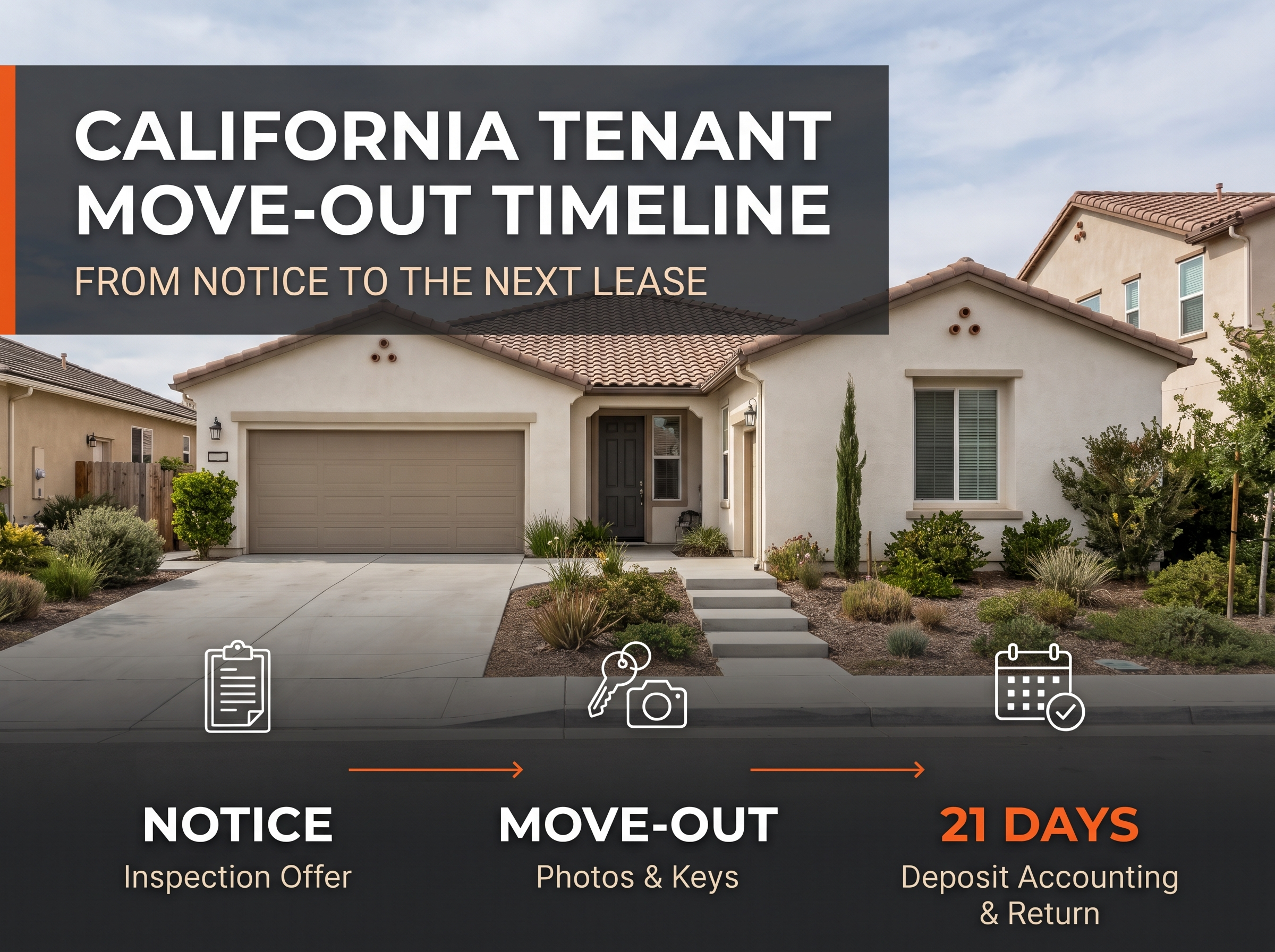
California landlords face two separate clocks when a tenant moves out. The duty to offer a pre-move-out inspection under Civil Code §1950.5(f) arises within a reasonable time after either side announces the tenancy is ending. The 21-day security deposit deadline under the same section starts when the tenant vacates.
This guide puts every step on one timeline, from notice to the next lease, with the code section behind each one. It also prices the gap between tenants: at the San Diego County average asking rent of $3,363 in RentCast data retrieved October 27, 2026, each vacant day is worth about $111 in rent.
It covers a tenant who leaves at the end of a lease or on proper notice. A tenant who leaves before a fixed term ends is covered in our guide to what happens when a tenant breaks a lease in California.
What does a California landlord have to do when a tenant moves out?
Three steps under Civil Code §1950.5:
- When notice is given: within a reasonable time, offer a pre-move-out inspection in writing.
- When the tenant vacates: photograph the home before any cleaning or repairs.
- Within 21 calendar days: send an itemized statement, with receipts for repair and cleaning charges over $125, and the rest of the deposit, electronically if it or the rent was paid that way unless agreed otherwise in writing.
Belongings left behind need written notice before disposal (§§1980 to 1991).
| When | Step | Civil Code |
|---|---|---|
| Notice received | Give written notice of the option to request a pre-move-out inspection and be present, and of electronic deposit return. Recommended: confirm the move-out date in writing. | §1950.5(f)(1); AB 414 |
| Before move-out | Show the home in business hours on written notice; 24 hours is presumed reasonable. | §1954(a), (d) |
| No earlier than 2 weeks before move-out, if requested | Hold the initial inspection on at least 48 hours' written notice, unless both sign a waiver. Give an itemized statement of proposed deductions. | §1950.5(f)(1), (2) |
| Up to move-out | The tenant may remedy the listed items. | §1950.5(f)(3) |
| Move-out day | Possession returns. Photograph before any cleaning or repairs. Recommended: collect all keys and a forwarding address in writing. | §1950.5(g)(2) |
| After repairs | Photograph again once repairs or cleaning are done. | §1950.5(g)(2) |
| Belongings left | Written notice to reclaim: at least 15 days if delivered personally, 18 if mailed. | §§1983, 1984 |
| Day 21 after vacating | Itemized statement and remaining deposit. Documents for repair and cleaning charges unless they total $125 or less. | §1950.5(h) |
| Repairs not done by day 21 | Deduct a good-faith estimate; send documents within 14 days of completion. | §1950.5(h)(3) |
| Next lease | Set the new starting rent. Stove and refrigerator for leases entered on or after Jan 1, 2026. Move-in photos. | §1947.12(b); §1941.1; §1950.5(g)(1) |
Source: California Civil Code §§1941.1, 1947.12, 1950.5, 1954, 1983 and 1984, text read November 17, 2026; AB 414 (Chapter 340, Statutes of 2025). Day 21 counts calendar days from the date the tenant vacates.
San Diego rental owners
Your tenant gave notice. What should the next lease RENT for?
Price it from today's listings, not last year's lease. See what comparable homes in your ZIP are asking right now, and the number a licensed broker would list yours at.
See What My Property Could Rent For →Free. Broker-reviewed. No obligation. Or call (619) 456-0000.
In this guide
- How Much Notice Ends a California Tenancy?
- What Is the Pre-Move-Out Inspection Under Civil Code §1950.5(f)?
- Can You Show and Price the Home Before the Tenant Leaves?
- What Does Each Day Between Tenants Cost in San Diego County?
- What Should Happen on Move-Out Day?
- What Can Come Out of the Deposit, and What Is Ordinary Wear and Tear?
- What Is Due Within 21 Days After the Tenant Vacates?
- How Does Realty Management Group Handle Tenant Move-Outs in San Diego?
- What If the Tenant Leaves Belongings Behind?
- What If the Tenant Does Not Leave on the Date Given?
- What Changes When the Next Lease Is Signed?
- Move-Out Terms Defined
- Frequently Asked Questions About Tenant Move-Out in California
- Sources
How Much Notice Ends a California Tenancy?
A tenant in a typical month-to-month tenancy must give at least 30 days' written notice to move out, under Civil Code §1946 and §1946.1(b), which requires a tenant's notice to be at least as long as the rental period. Rent is owed through the termination date.
A landlord ending a periodic tenancy generally must give at least 60 days' notice under §1946.1(b), or 30 days under §1946.1(c) when a tenant or resident has lived there less than one year, and just-cause rules may bar ending it at all. Notices under §1946.1 are served as Code of Civil Procedure §1162 prescribes, or by certified or registered mail (§1946.1(f)).
A fixed-term lease runs to its stated end date; check the lease for any notice it requires and for what happens if the tenant stays on. A tenant who leaves before that date without a legal ground is in breach, which carries different remedies, set out in our lease-break guide.
When the owner, not the tenant, ends the tenancy
Then the notice is only half of it. For tenancies AB 1482 covers, once a tenant has continuously and lawfully occupied for 12 months, the owner needs a just-cause reason stated in the written notice (§1946.2(a)). The expiration of a fixed-term lease is not one of the listed reasons.
Local rules go further. In the City of San Diego (SDMC Chapter 9, Article 8, Division 7) and in Chula Vista (CVMC Chapter 9.65), just cause applies from the first day of the tenancy; our San Diego just-cause guide covers the City ordinance.
Imperial Beach keeps the state 12-month threshold but requires notice to the City within three business days of serving a termination notice, unless an exemption in the ordinance applies (IBMC Chapter 9.90). No-fault terminations carry relocation payments, listed by city in our relocation assistance guide.
Bottom line: get the move-out date in writing, and if you are the one ending the tenancy, check just cause and local rules before serving anything.
What Is the Pre-Move-Out Inspection Under Civil Code §1950.5(f)?
The pre-move-out inspection, which the statute calls an initial inspection, is a walk-through before the tenant leaves, so the tenant can see and fix what the landlord expects to deduct. Within a reasonable time after either side announces an intent to end the tenancy, or before the lease term ends, the landlord must notify the tenant in writing of the option to request one and the right to be present (§1950.5(f)(1)).
If the tenant asks for it, the landlord or an agent must perform it at a reasonable time no earlier than two weeks before the termination or lease end date, and proceeds whether or not the tenant attends, unless the tenant withdrew the request.
The landlord gives at least 48 hours' prior written notice of the date and time; landlord and tenant may forgo that notice by both signing a written waiver. If the tenant does not ask, the landlord's duties under the subdivision are discharged.
Based on the inspection, the landlord gives an itemized statement of the repairs or cleaning proposed as deductions, handed to the tenant if present or left inside the home, with the text of §1950.5(b)(1) to (4) included (§1950.5(f)(2)). The tenant may then remedy those items before moving out, in a manner consistent with the rental agreement (§1950.5(f)(3)).
Subdivision (f) does not apply when the tenancy ends under Code of Civil Procedure §1161(2), (3) or (4), the three-day notices for causes such as unpaid rent or a lease violation.
Does the inspection limit what can be deducted later?
Short answer: not for what it could not see. Paragraph (f)(5) keeps deductions for listed items the tenant did not cure. Paragraph (f)(6) keeps deductions for damage that arises after the inspection and the return of possession, and for damage not identified during the inspection because the tenant's belongings were in the way.
Send the written offer the day notice arrives, and hold the inspection close to move-out so the statement reflects the home as the tenant will leave it.
Bottom line: the offer is mandatory, the inspection is the tenant's choice, and a dated written offer is the proof you made it.
Can You Show and Price the Home Before the Tenant Leaves?
Yes, within limits. Civil Code §1954(a) lets a landlord enter to exhibit the unit to prospective tenants, and to make the §1950.5(f) inspection. Entry must be during normal business hours unless the tenant consents at the time, on reasonable written notice giving the date, approximate time and purpose. Twenty-four hours is presumed reasonable; mailed notice is presumed reasonable at six days (§1954(d)).
Showing while the tenant is still in the home is how the gap between tenants shrinks. The average house listing age across 73 San Diego County ZIP codes was 31 days in RentCast data retrieved October 27, 2026, and our guide to how long it takes to rent a house in San Diego ranks every ZIP. Marketing early does not remove make-ready: repairs and cleaning still happen after the tenant leaves.
Set the asking rent before marketing begins, from comparable rentals with similar bedrooms, bathrooms, square footage, condition, amenities and location. ZIP-code averages give market context, but comparable rentals set the asking price. Our average rent by ZIP code table and San Diego rental pricing guide explain the data and method, and the next-lease section below covers the legal rules for a new tenant's starting rent.
Bottom line: give 24 hours' written notice, show during business hours, and have the price set before the first showing.
What Does Each Day Between Tenants Cost in San Diego County?
At the countywide average asking rent of $3,363 a month, a vacant day is worth about $111 in rent: $3,363 times 12, divided by 365. That average is listing-weighted across 15,963 listings in 77 ZIP codes in RentCast data retrieved October 27, 2026. At that rent, 7 vacant days represent about $777 and 30 vacant days about $3,330 in potential rent. These examples illustrate lost rent, not actual vacancy durations.
| Area and ZIP | Avg house rent | Per day | Days listed | Rent equivalent | Listings |
|---|---|---|---|---|---|
| Coronado 92118 | $6,213 | $204 | 127 | $25,908 | 104 |
| Imperial Beach 91932 | $3,865 | $127 | 47 | $5,969 | 89 |
| Spring Valley 91977 | $3,487 | $115 | 44 | $5,060 | 44 |
| Mission Valley 92108 | $3,147 | $103 | 46 | $4,738 | 29 |
| Poway 92064 | $4,956 | $163 | 22 | $3,586 | 34 |
| Escondido 92025 | $3,790 | $125 | 28 | $3,500 | 35 |
| Chula Vista 91910 | $3,216 | $106 | 29 | $3,074 | 65 |
| Santee 92071 | $3,763 | $124 | 22 | $2,728 | 42 |
| El Cajon 92020 | $3,500 | $115 | 19 | $2,185 | 37 |
| Lemon Grove 91945 | $3,461 | $114 | 18 | $2,052 | 27 |
| National City 91950 | $2,465 | $81 | 20 | $1,620 | 43 |
| La Mesa 91942 | $3,364 | $111 | 14 | $1,554 | 33 |
Source: RentCast, ZIP-level rental market data for single-family listings, retrieved October 27, 2026 through Realty Management Group's RentCast account. Rent per day is average asking rent times 12, divided by 365, rounded to the dollar; rent equivalent is rent per day times the average listing age rounded to the day. Listing age counts listings still active and is not time to lease. Asking rent is not signed rent.
These figures illustrate the rent associated with each ZIP code's average listing age; they are not actual vacancy losses. Listing age measures how long advertised homes have been on the market, including homes still available, so it does not show how long any property sat empty or what any landlord lost.
Actual vacancy cost depends on the move-out date, when marketing starts, the home's condition, the asking rent and when the next tenancy begins. In Coronado 92118 a house listing averaged 127 days, a rent equivalent of $25,908; in La Mesa 91942, 14 days and $1,554.
RMG data: days from vacancy to signed lease
Result: 13 days
Methodology: Days to lease is the mean across more than 40 RMG-managed San Diego County leases signed in the trailing 24 months ending August 2026, measured from vacancy date to signed lease date. Marketing time before the vacancy date is not counted, and a lease can be signed before the new tenancy starts, so this is not the number of days a home sat empty. A past average, not a guarantee.
Source: RMG internal Rentvine management data; not independently verifiable. RMG has not published a make-ready duration or turnover cost, and this page does not estimate one.
Comparison: RentCafe's 2025 year-end national figure is 41 days, measured as total days vacant for apartments: context, not a controlled comparison. Not comparable to RentCast listing age, which starts at listing.
Bottom line: at about $111 a day in county average rent, every day between move-out and the next lease has a price, and showing before move-out is how to cut the count.
Flat-fee property management
30 vacant days can cost thousands. RMG can HELP.
We price it, lease it and manage it for a flat $199 a month at rents up to $5,000. Our 40+ leases in the 24 months to August 2026 averaged 13 days from vacancy to signed lease.
Have RMG Lease My Property →$3,330 is 30 days at the county average asking rent. 13 days is a past average, not a guarantee. First three months of management are free if you decide to hire us. Or call (619) 456-0000.
What Should Happen on Move-Out Day?
Move-out day is when possession comes back to the landlord, and two clocks start. The 21-day deposit clock runs from the date the tenant vacates (§1950.5(h)(1)). The photo requirement runs from the return of possession: since April 1, 2025, the landlord must photograph the unit within a reasonable time after possession is returned and before any repairs or cleaning, and again after repairs or cleaning are completed (§1950.5(g)(2); the photo rules came from AB 2801).
On the day itself: collect every key, fob, remote and parking pass; confirm in writing the date possession was returned; get a forwarding address in writing; and take the move-out photos before a cleaner or contractor walks in.
Once the tenant has surrendered the home, §1954(e) removes the notice requirement for entry. A tenant who instead disappears with rent unpaid has not surrendered; that is abandonment, which has its own notice procedure under Civil Code §1951.3, explained in our lease-break guide.
Bottom line: photographs come before the first cleaner walks in; without them, the deposit statement is missing a record the statute requires.
What Can Come Out of the Deposit, and What Is Ordinary Wear and Tear?
Under §1950.5(b), a deposit may be applied to four things. Unpaid rent. Repair of damage beyond ordinary wear and tear caused by the tenant or the tenant's guests or licensees. Cleaning needed to return the unit to the level of cleanliness it had at the start of the tenancy. And, if the lease authorizes it, restoring, replacing or returning personal property or appurtenances.
Subdivision (e)(2) narrows that further. A landlord may not claim for conditions that existed before the tenancy, or for ordinary wear and tear or its cumulative effects. Charges for materials and work are limited to a reasonable amount needed to restore the premises to their condition at the start of the tenancy. And a landlord may not charge for professional carpet or other professional cleaning unless it is reasonably necessary to restore that starting condition.
What counts as ordinary wear and tear?
Short answer: aging from normal use, as opposed to damage. The statute gives no examples, but the line is commonly drawn this way: paint faded or lightly scuffed with age versus walls stained, marked or holed; flooring worn along walking paths versus burns, pet stains or gouges; an appliance worn out by normal use versus one broken by misuse; ordinary household dust versus cleaning needed to reach move-in condition.
Age matters too. A charge is limited to a reasonable amount to restore the condition at the start of the tenancy, excluding wear (§1950.5(e)(2)(B)), so replacing an item that was already partly worn at move-in with a new one can exceed that limit. Replacement charges are commonly prorated for the item's age.
Photos are what turn that judgment into evidence. Move-in photos are required for tenancies beginning on or after July 1, 2025 (§1950.5(g)(1)), and they are the baseline the move-out photos are compared against.
The deposit itself is capped. Since July 1, 2024 (AB 12), most California landlords may collect no more than one month's rent. Our San Diego County security deposit guide covers the cap, its small-landlord exception and the photo rules in detail.
Bottom line: deduct for damage and for cleaning back to move-in condition, at a reasonable cost, and never for age.
What Is Due Within 21 Days After the Tenant Vacates?
No later than 21 calendar days after the tenant vacates, the landlord must send an itemized statement of deductions and return the rest of the deposit (§1950.5(h)(1)). A tenant who vacates on Friday, November 27, 2026 is owed the statement and any balance no later than Friday, December 18.
The statement must include copies of documents showing the charges incurred to repair or clean: the bill, invoice or receipt from an outside vendor, or, for work by the landlord or an employee, a description of the work with the time spent and a reasonable hourly rate (§1950.5(h)(2)). That applies unless repair and cleaning deductions together total $125 or less (§1950.5(h)(4)(A)).
If repairs cannot be finished within the 21 days, the landlord may deduct a good-faith estimate, then provide the documents within 14 calendar days of completing the repair or receiving the documentation (§1950.5(h)(3)).
How the deposit goes back changed on January 1, 2026
Under AB 414 (Chapter 340, Statutes of 2025), a landlord who received the security deposit or rent payments by electronic transfer returns the rest of the deposit electronically, to a bank account or other financial institution the tenant designates in writing, unless landlord and tenant agree in writing on another method (§1950.5(h)(1)(A)(ii)).
The landlord must tell the tenant of this right in writing within a reasonable time after either side gives notice of termination, unless they already agreed on another method or the tenancy ends by a three-day notice under CCP §1161(2), (3) or (4). By mutual agreement, the itemized statement may be emailed (§1950.5(h)(1)(B)). Send this notice with the inspection offer.
Getting it wrong is expensive. Retaining a deposit in bad faith can bring statutory damages of up to twice the amount of the deposit, in addition to actual damages (§1950.5(m)).
Bottom line: count 21 calendar days from the day the tenant vacates, attach the invoices, and send the money back the way it came in.
How Does Realty Management Group Handle Tenant Move-Outs in San Diego?
Realty Management Group manages the rental turnover for San Diego County owners, coordinating the required notices, inspections, property-condition photos, security deposit accounting, repairs and cleaning through maintenance services, marketing, tenant screening and lease preparation.
Management costs a flat $199 per month for properties renting for $5,000 or less, or 5% of monthly rent for properties renting above $5,000. RMG charges no leasing fees, renewal fees, setup fees or maintenance markups. The owner does not have to coordinate the inspection, the contractors, the showings or the deadlines.
What If the Tenant Leaves Belongings Behind?
Personal property left after a tenancy ends is handled under Civil Code §§1980 to 1991, with notice first. The landlord gives written notice to the former tenant, and to anyone the landlord reasonably believes owns the property (§1983). If the owner ended the tenancy, the §1946.1 notice should already have carried the statutory statement on reclaiming abandoned property (§1946.1(h)).
The notice describes the property well enough to identify it, says where it can be claimed and that reasonable storage costs may be charged, and sets a claim deadline at least 15 days after personal delivery or 18 days after mailing. Section 1984 supplies the form.
If the total resale value of what is not reclaimed is reasonably believed to be under $700, the landlord may keep, sell or destroy it after the deadline, and the notice says so. Above $700, the property must be sold at public sale by competitive bidding, and the balance after storage, advertising and sale costs goes to the county treasury, where the owner may claim it within one year (§1988).
Store it safely in the meantime. Property left after an eviction judgment follows a separate procedure; ask the eviction attorney handling the case.
Bottom line: photograph and list what was left, send the §1983 notice, and let the 15- or 18-day claim period run before keeping or disposing of anything: under $700 the landlord may keep, sell or destroy it, above $700 it goes to public sale. Do not discard belongings on move-out day.
What If the Tenant Does Not Leave on the Date Given?
A tenant who gives written notice under §1946, or makes a written offer to surrender that the landlord accepts in writing, and then fails to deliver possession at the time specified without the landlord's permission, is guilty of unlawful detainer under Code of Civil Procedure §1161(5). Where AB 1482 just cause applies, §1946.2(b)(1)(K) lists the same failure as an at-fault just cause.
Be careful with rent. Under Civil Code §1945, if a tenant stays after the hiring expires and the landlord accepts rent, the parties are presumed to have renewed on the same terms, for no more than one month where rent is paid monthly. Speak with an eviction attorney before accepting money for any period past the move-out date. See RMG's eviction services.
If the tenant leaves early instead, before a fixed term ends, the landlord's recovery is reduced by any rent loss the tenant proves could reasonably have been avoided. The remedies are in our guide to a tenant breaking a lease.
Bottom line: a tenant who gave valid written notice and stays past the date without permission gives the landlord grounds for unlawful detainer under CCP §1161(5); the notice, the facts and any just-cause rules decide the remedy, and accepting rent for later days can be presumed to renew the tenancy.
What Changes When the Next Lease Is Signed?
The starting rent. For a new tenancy in which no tenant from the prior tenancy remains in lawful possession, Civil Code §1947.12(b) lets the owner establish the initial rental rate outside the AB 1482 cap; the cap governs increases after that. Our review of San Diego rent control by city lists the local ordinances, and none of those reviewed adds a local rent cap.
One condition can sit on top of that. During a qualifying declared emergency, Penal Code §396(e) bars raising the rental price advertised, offered or charged for housing by more than 10% over the price before the declaration, including the rent set for a new tenancy. State and local declarations can each trigger it, so check the Cal OES price-gouging list and any local declaration before advertising a new rent.
The kitchen. For a lease entered into, amended or extended on or after January 1, 2026, a working stove and refrigerator are part of habitability under Civil Code §1941.1 (AB 628), with limited exceptions and a narrow tenant-supplied refrigerator option. Our AB 628 guide covers the details.
The record. Take move-in photos immediately before or at the start of the tenancy (§1950.5(g)(1)); they are the baseline the next move-out is measured against. Collect a deposit within the AB 12 cap.
The exemption notice. An owner relying on the AB 1482 exemption for a single-family home or condominium, available only to qualifying non-corporate owners, must include the statutory exemption notice in the rental agreement for tenancies commenced or renewed on or after July 1, 2020 (§§1946.2(e)(8)(B), 1947.12(d)(5)(B)). The new lease is the place to put it.
Bottom line: a turnover resets the rent, the kitchen standard, the photo baseline and the exemption notice, so build all four into the new lease.
Move-Out Terms Defined
Initial inspection: The pre-move-out walk-through a tenant may request under Civil Code §1950.5(f).
Itemized statement: The written accounting of deposit deductions, due within 21 calendar days after the tenant vacates.
Ordinary wear and tear: Deterioration from normal use over time. It cannot be charged to the tenant or the deposit (§1950.5(e)(2)).
Listing age: RentCast's average days on the market of listed properties, including listings still active.
Frequently Asked Questions About Tenant Move-Out in California
How long does a landlord have to return a security deposit in California?
Twenty-one calendar days after the tenant vacates, under Civil Code §1950.5(h)(1). The landlord sends an itemized statement and the rest of the deposit, with invoices or receipts for repair and cleaning charges over $125. If repairs run past day 21, a good-faith estimate may be deducted, with documents within 14 days of completion. Bad-faith retention can cost up to twice the deposit (§1950.5(m)).
Does a landlord have to do a walk-through before a tenant moves out in California?
The landlord has to offer one, in writing, within a reasonable time after either side announces the tenancy is ending (Civil Code §1950.5(f)(1)). If the tenant asks, the landlord holds it no earlier than two weeks before move-out, on 48 hours' written notice unless both sign a waiver, and lists the proposed deductions. The duty does not apply after a three-day notice under Code of Civil Procedure §1161(2), (3) or (4).
Can a landlord show a rental while the tenant still lives there?
Yes, to prospective tenants, during normal business hours, on reasonable written notice giving the date, approximate time and purpose. Civil Code §1954 presumes 24 hours' written notice is reasonable, or six days if mailed. Entry outside business hours needs the tenant's consent at the time. Repairs and cleaning still follow the move-out.
How much notice does a tenant have to give to move out in California?
At least 30 days' written notice for a month-to-month tenancy under Civil Code §1946, and generally notice at least as long as the rental period under §1946.1(b). A fixed-term lease runs to its stated end date, so check the lease for any notice it requires. Leaving before the end of a fixed term without a legal ground is a breach of the lease, with remedies under Civil Code §1951.2.
What counts as normal wear and tear in California?
Deterioration from ordinary use over time. Civil Code §1950.5(e)(2) bars charging for it, or for conditions that existed before the tenancy, but gives no examples. Faded paint and carpet worn along walking paths are commonly treated as wear; burns, pet stains and broken fixtures as damage. Replacement charges are commonly prorated for the item's age.
Can a landlord charge for professional carpet cleaning in California?
Only when it is reasonably necessary to return the home to its condition at the start of the tenancy, excluding ordinary wear and tear. Civil Code §1950.5(e)(2)(C) otherwise bars requiring the tenant to pay for professional carpet or other professional cleaning, or claiming it against the deposit. Cleaning in general is limited to restoring the level of cleanliness the unit had at move-in (§1950.5(b)(3)).
Does a landlord need receipts for security deposit deductions?
Yes, when repair and cleaning deductions together exceed $125. Civil Code §1950.5(h)(2) requires copies of documents showing those charges, and §1950.5(h)(4)(A) lifts the requirement at $125 or less. For an outside vendor that means the bill, invoice or receipt; for work by the landlord or an employee, a description of the work, the time spent and a reasonable hourly rate (§1950.5(h)(2)).
Do California landlords have to return security deposits electronically?
Often, since January 1, 2026. Under AB 414 (Chapter 340, Statutes of 2025), a landlord who received the deposit or rent by electronic transfer returns the deposit electronically, to an account the tenant designates in writing, unless both sides agree in writing on another method. The landlord must tell the tenant about this right in writing within a reasonable time after either side gives notice of termination.
What can a landlord do with belongings a tenant leaves behind?
Send written notice under Civil Code §1983 to the former tenant and anyone believed to own the property, describing it, saying where to claim it and that storage costs may be charged, with a deadline at least 15 days after personal delivery or 18 days after mailing. If total resale value is reasonably believed to be under $700, the landlord may then keep, sell or destroy it (§1988); above $700 it goes to public sale.
What if a tenant gives notice but does not move out?
A tenant who gave written notice under Civil Code §1946, or whose written offer to surrender was accepted in writing, and then fails to deliver possession at the time specified without permission, is guilty of unlawful detainer under Code of Civil Procedure §1161(5). Under Civil Code §1945, accepting rent for later days presumes a renewal, so talk to an eviction attorney first.
Can a landlord raise the rent for the next tenant in California?
Generally yes. For a new tenancy in which no tenant from the prior tenancy remains in lawful possession, Civil Code §1947.12(b) lets the owner set the initial rent outside the AB 1482 cap, which then applies to later increases. An emergency price limit under Penal Code §396 still applies while one is in force. Price from comparable rentals, with the ZIP and bedroom average as context.
How long does it take to turn over a rental in San Diego?
RMG has not published a make-ready duration, and this page does not estimate one. RentCast's average house listing age across 73 San Diego County ZIP codes was 31 days in data retrieved October 27, 2026, counting listings still active. RMG's own figure is 13 days from vacancy date to signed lease, the mean across more than 40 RMG-managed San Diego County leases signed in the trailing 24 months ending August 2026.
Sources
California statute text was read November 17, 2026.
Civil Code §1950.5. As amended by AB 12, AB 2801 and AB 414. Every other code section, the local ordinances and RentCafe are linked where cited above.
AB 414; DRE 2025 bill summaries. Electronic deposit return and notice of that right.
AB 2801. Move-out photos from April 1, 2025; move-in photos for tenancies from July 1, 2025.
Penal Code §396; Cal OES price-gouging list. Emergency 10% limit; current state declarations.
RentCast. ZIP asking rents and listing age, retrieved October 27, 2026. Asking rents, not signed leases.
RMG internal Rentvine data. 13 days, vacancy to signed lease, 40+ leases, 24 months ending August 2026. Not independently verifiable.
Your property, your number
You've seen the timeline. Now let's price YOUR address.
A licensed broker prices your home against the live comparables in your ZIP and tells you the number, and the reasoning behind it. Whether or not you hire us.
Get My Property's Rental Price →Call (619) 456-0000Free. No obligation. Rated 4.9 stars across 127 Google reviews.
Realty Management Group, 4025 Camino Del Rio South, Suite 300, San Diego, CA 92108. (619) 456-0000.
About the Author
Scott Engle is the Broker/Owner of Realty Management Group (DRE #01332676, Corp DRE #02075336). He has been a licensed California real estate broker since 2002, has managed San Diego County rental property since 2003, and founded Realty Management Group in 2005. As of August 2026, RMG manages 400+ units countywide, with management starting at a flat $199 per month, and holds a 4.9-star rating across 127 Google reviews. RMG has been named Best Property Management Company in San Diego by Expertise.com in 2023, 2024, and 2025.
Related Articles
- What Happens When a Tenant Breaks a Lease in California?
- How Long Does It Take to Rent a House in San Diego?
- Security Deposits in San Diego County
- How to Price a Rental in San Diego
Areas We Serve: Lakeside · Rancho San Diego · Mt. Helix · Alpine · Pacific Beach · Mira Mesa
This article is general information about California and San Diego County rules as of November 17, 2026, not legal advice. Statutes and ordinances change, and outcomes depend on the lease and the facts. RentCast figures are asking rents and listing ages retrieved October 27, 2026, not signed rents or a forecast for any property. RMG figures are internal management data and are not independently verifiable. Consult a qualified attorney on your own facts.