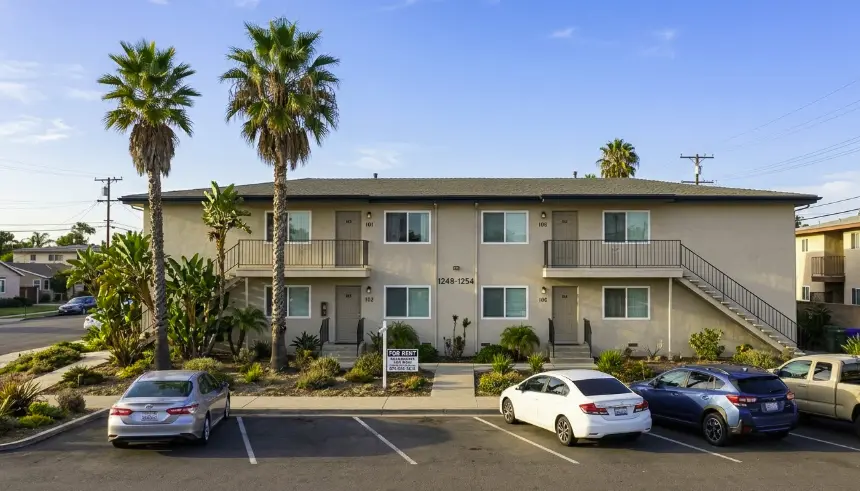
San Diego Multifamily
Updated August 2026 · Scott Engle, Broker DRE #01332676, Corp DRE #02075336 · Realty Management Group · San Diego County, CA
Last verified against primary sources: August 20, 2026. Competitor figures retrieved from published pricing pages, August 2026. See Methodology and Sources.
Using published August 2026 fee schedules and the same six-unit assumptions, annual management cost differs by as much as $8,572 — even when both advertised rates look competitive side by side. The difference never appears on a single invoice, which is why it is easy to miss.
If you own a small apartment building, you have probably noticed the pattern without naming it. The management fee on the statement looks reasonable. Repairs come back higher than the vendor quoted. A tenant moves out and a charge appears that you do not remember agreeing to. At the end of the year the cash flow is a few thousand dollars short of what the spreadsheet said, and no single line item explains it.
That is what this page is about. Not the advertised percentage — the per-unit minimums and per-event charges underneath it that multiply by every door you own. Every competitor fee figure below comes from a published San Diego fee schedule, and the arithmetic is shown so you can run it on your own building.
Quick answers
What does multifamily property management cost in San Diego?
Published rates for buildings of five or more units run around 6% of collected rent with a per-unit monthly minimum near $170, or 8% with no minimum on smaller buildings. Add a leasing fee of up to 25% of one month's rent per placement, renewal fees up to $195 per unit, inspection fees of $150–$250, and maintenance markups up to 10%. On a six-unit building at $3,500 per unit, published schedules produce annual totals of $12,888 to $21,460 — effective rates of 5.1% to 8.5% of gross rent.
What is a per-unit monthly minimum, and why does it matter?
A floor beneath the percentage, applied to each door separately. It can be one of the most consequential lines on a multifamily fee schedule, because it determines the actual management charge whenever the percentage calculation falls below the floor. A published 6% rate with a $170 per-unit floor is an effective 9.4% on a $1,800 unit and 7.7% on a $2,200 unit. The floor binds on any unit renting below about $2,833.
Is flat-fee management cheaper for multifamily?
Usually, but not always, and not for the reason most people assume. Realty Management Group's $179 per unit is cheaper than an 8% rate above $2,238 in monthly rent, and cheaper than a 6% tier above $2,983. Below those thresholds the percentage wins on base management, and the flat fee's advantage comes entirely from carrying no leasing, renewal, inspection, or markup fees.
Does Realty Management Group charge leasing or renewal fees?
No. The $179 per unit per month covers tenant placement, leasing, renewals, inspections, and maintenance coordination. No leasing fee, no renewal fee, no inspection fee, no maintenance markup, no setup fee. The rate is $199 per month for 1–3 units and $179 per unit for 4–16 units, with 6% applying above $5,000 in monthly rent per unit.
Every competitor figure on this page comes from that company's own published pricing page, retrieved August 2026, and is named in the methodology at the foot of the post. Where a company does not publish a fee, this page says so rather than estimating.
In this guide
- The per-unit minimum: the line that decides everything
- The published multifamily fee stack
- Worked example: six units at $3,500
- The breakeven rent, by percentage
- Cost by building size
- What this does to NOI and value
- Compliance costs specific to multifamily
- What $179 per unit includes
- Frequently asked questions
- Methodology and sources
The Per-Unit Minimum: The Line That Decides Everything
Most multifamily fee comparisons start with the percentage. That is the wrong starting point, because published San Diego schedules apply a monthly minimum per unit, and on a multi-door building the floor usually binds before the percentage does.
One San Diego company publishes 6% of collected rent for buildings of 5–15 units, with a minimum of $170 per unit per month. Sources for every figure on this page are named in the methodology at the foot of the post. Here is what that rate actually costs at different rent levels:
A published 6% rate, at real rents
With a $170 per-unit monthly floor applied
$1,800 rent — 6% would be $108, you pay $170
9.4%
$2,200 rent — 6% would be $132, you pay $170
7.7%
$2,800 rent — 6% would be $168, you pay $170
6.1%
The floor binds on any unit renting below about $2,833. Below that, you are not paying 6% — you are paying a fixed $170 per door dressed as a percentage.
This is not a criticism of that schedule. It is published clearly and it is a defensible way to price. The point is that comparing it to a competitor's 8% tells you almost nothing until you know both minimums and your own rents.
Comparing percentages alone is not enough. On a multi-door building, a per-unit minimum can decide what you actually pay whenever the percentage calculation falls below the floor.
The Published Multifamily Fee Stack
Below are the fee schedules published by San Diego County companies for multi-unit residential buildings. Where a company does not publish a figure, that is stated rather than filled in.
Table 1. Published multifamily management fee schedules, San Diego County, retrieved August 2026.
| Fee | 6% multifamily tier | 8%, no leasing fee | RMG flat fee |
|---|---|---|---|
| Monthly rate | 6% (5–15 units) 8% (2–4 units) | 8% | $179/unit flat (4–16) $199/mo (1–3) |
| Per-unit minimum | $170/unit (5–15) $210/unit (2–4) | None published | None — flat is flat |
| Leasing fee | 25% of one month's rent | None on full mgmt | None |
| Renewal fee | $195 per unit | Included | None |
| Annual inspection | $150 per unit | $250 | None |
| Maintenance markup | None published | 10% coordination fee | None |
| Turnover marketing | Included in leasing fee | $250 | None |
| Out-of-state tax handling | $50 per quarter | None published | None |
| Setup / onboarding | None | None published | None |
A third San Diego company publishes 8–10% with no leasing or renewal fees, but does not publish an inspection fee or maintenance markup, so it is not included in the worked comparisons below.
What did your building cost you last year?
Not the percentage. The number. Management, leasing, renewals, inspections, markups — every door, twelve months, one figure. Almost no owner can answer it, because no statement ever adds it up.
Send us your fee schedule and unit mix. We will add it up and send it back, free, whether you hire us or not.
Get My Number Call (619) 456-0000Worked Example: Six Units at $3,500
A six-unit building at $3,500 per unit — $252,000 in gross annual rent. One unit turns over during the year, five renew. Assume $8,000 in total repair spend and one annual inspection cycle.
Same building. Same year. Three bills.
Six units at $3,500, one turnover, calculated from published fee schedules
8% schedule, no leasing fee
$20,160 management + $250 inspection + $250 turnover marketing + $800 coordination
$21,460
6% schedule with a $170/unit floor
$15,120 management + $875 leasing + $975 renewals + $900 inspections
$17,870
Realty Management Group — $179/unit flat
$12,888 management, and nothing else
$12,888
$4,982 to $8,572 a year depending on which schedule you compare against. Effective rates: 8.5%, 7.1%, and 5.1% of gross rent.
The Breakeven Rent, by Percentage
The arithmetic is simple: divide the flat fee by the percentage. Above the resulting rent, the flat fee is cheaper on base management alone, before any event fees enter the calculation.
Breakeven rent = $179 ÷ the percentage
Against 6% — $2,983 per month
Against 7% — $2,557 per month
Against 8% — $2,238 per month
Against 9% — $1,989 per month
Against 10% — $1,790 per month
Two cautions. This compares base management only. Leasing, renewal, inspection, and markup fees all sit on top of the percentage column and move the real breakeven substantially lower. And if the percentage carries a per-unit minimum, the minimum governs at lower rents rather than the percentage, so run the floor first.
That distinction matters when you compare. A 6% tier with a $170 floor has a lower base rate than $179 flat on any unit under $2,983 — but on the six-unit building above, its all-in bill still comes to $17,870 against $12,888, because the base rate was never where the money was.
Cost by Building Size
All figures at $3,500 per unit, calculated from the published schedules above, with one turnover per year on buildings up to six units and two on larger ones.
Table 2. Annual management cost by building size, San Diego County, calculated from published August 2026 schedules at $3,500 per unit.
| Units | 6% multifamily tier | 8%, no leasing fee | RMG flat | Annual gap |
|---|---|---|---|---|
| 4 units | $15,500 | $14,740 | $8,592 | $6,148–$6,908 |
| 6 units | $17,870 | $21,460 | $12,888 | $4,982–$8,572 |
| 8 units | $24,280 | $28,430 | $17,184 | $7,096–$11,246 |
| 10 units | $30,010 | $35,150 | $21,480 | $8,530–$13,670 |
The four-unit row uses the 8% tier with a $210 per-unit minimum, since that schedule's 6% tier begins at five units. Change the rent, the turnover assumption, or the repair spend and these totals move — the calculation is shown above so you can run your own.
What This Does to NOI and Value
Management fees are an operating expense, so they reduce net operating income dollar for dollar. NOI is a central input in the income approach to multifamily valuation, so a permanent reduction in a recurring expense can affect value as well as cash flow.
On the six-unit example, a $4,982 annual difference at a 4.7% cap rate corresponds to roughly $106,000 in value. Against the higher-cost schedule, an $8,572 difference corresponds to roughly $182,000.
Three caveats, stated plainly, because this calculation is often abused.
The 4.7% figure used here is the San Diego County multifamily average reported by Kidder Mathews and Northmarq for Q2 2026, with East County and inland value-add typically in the 4.5% to 5.5% range. It is a market average, not a quote on your building, and cap rates vary by submarket, building class, condition, and the month you ask.
The value effect only holds while the expense difference holds. Switch back and it goes with you. This is not a one-time gain you bank.
And a one-time cost, like a single month of vacancy, does not capitalize this way. Only a recurring change in annual expense does. Treat this as a way of understanding why ongoing costs matter more than they look, not as an appraisal.
Compliance Costs Specific to Multifamily
Every compliance obligation below repeats on every door, which is why it belongs in a cost discussion rather than a separate legal one.
AB 1482 — rent cap and just cause. Multi-unit apartment buildings do not qualify for the single-family and condo exemption. AB 1482 generally applies once a property is more than 15 years past the date its certificate of occupancy was issued, subject to the statute's other exemptions, and that threshold rolls forward every year. The San Diego County cap is 8.2% for August 1, 2026 through July 31, 2027 — 5% plus a 3.2% CPI reading — and it resets each August 1. Civil Code §1947.12(a)(2) permits up to two increases in a twelve-month period for a continuing tenant, provided the cumulative total stays within the cap. Under a percentage agreement, applying that increase raises your management fee automatically on every unit. Under a flat fee it does not.
AB 628 — appliances, effective January 1, 2026. A working stove and refrigerator are required for every lease entered into, amended, renewed, or extended on or after that date (Civil Code §1941.1). A separate 30-day deadline applies where either appliance is subject to a manufacturer or public-entity recall. On a multi-unit building the obligation repeats per unit, and older stock carries the most exposure. If your manager charges a markup on vendor invoices, every appliance replacement carries that markup with it.
AB 2801 — deposit documentation, two dates. Since April 1, 2025, move-out photographs are required immediately after the tenancy ends and before any cleaning or repair, plus post-repair photographs where a deduction is claimed, for all tenancies regardless of start date. Since July 1, 2025, move-in photographs are also required, but only for tenancies beginning on or after that date. Shared and common areas in a multi-unit building add documentation the single-family workflow does not cover.
AB 12 — security deposits. One month's rent for most California residential landlords under Civil Code §1950.5. The two-month exception is limited to a natural-person owner of no more than two residential properties totalling four or fewer units, which excludes most multifamily ownership. Military tenants are always capped at one month.
AB 2493 — application screening fees. Effective January 1, 2025, codified at Civil Code §1950.6. Written criteria must be provided to applicants and disclosed before any screening fee is collected, applications are considered in the order received, and the fee may not exceed the actual out-of-pocket cost of gathering information. Refunds are due within seven days of selecting a tenant or thirty days of the application, whichever comes first. A building with several vacancies a year multiplies the exposure of a sloppy process.
For the full detail see the 2026 California rental laws overview, and for every fee charged in the San Diego market with published rates by company, our complete fee guide.
What $179 Per Unit Includes
Realty Management Group manages 1–16 unit properties throughout San Diego County. The multifamily rate is $179 per unit per month for 4–16 units, and $199 per month for 1–3 units, with 6% applying above $5,000 in monthly rent per unit. That single figure covers:
- Tenant marketing, screening, and placement — no leasing fee
- Lease preparation, execution, and renewals — no renewal fee
- Move-in and move-out inspections to AB 2801 standards — no inspection fee
- Rent collection and owner disbursements
- Maintenance coordination at vendor cost — no markup
- Lease enforcement and eviction coordination
- Monthly statements and owner portal — see accounting
- AB 1482, AB 12, AB 628, AB 2801, and AB 2493 compliance tracking
- No setup fee, no onboarding fee, and no per-unit minimum
Across the 400+ units we manage countywide
The four numbers worth asking any manager for. Ours, from internal Rentvine management data, as of August 2026
13 days
Average days to lease
39 months
Average tenant retention
99.4%
On-time rent collection
98.9%
Portfolio occupancy
First-party figures, not independently audited, published so you can hold us to the standard this page asks you to hold everyone else to. Full methodology in the 2026 performance data report.
Frequently Asked Questions
What does multifamily property management cost in San Diego?
Published San Diego rates for buildings of five or more units run around 6% of collected rent with a per-unit monthly minimum near $170, or 8% on smaller buildings. Additional published charges include a leasing fee of up to 25% of one month's rent per placement, renewal fees up to $195 per unit, inspection fees of $150 to $250, and maintenance coordination markups up to 10%. On a six-unit building at $3,500 per unit, those schedules produce annual totals between $12,888 and $21,460 — effective rates of 5.1% to 8.5% of gross rent.
What is a per-unit monthly minimum and why does it matter on a multifamily building?
A floor beneath the percentage, applied separately to each door. A published 6% rate with a $170 per-unit floor produces an effective 9.4% on an $1,800 unit, 7.7% on a $2,200 unit, and 6.1% on a $2,800 unit. The floor binds on any unit renting below about $2,833. It can be one of the most consequential lines on a multifamily fee schedule, because it determines the actual management charge whenever the percentage calculation falls below the floor.
Is flat-fee management always cheaper for multifamily?
No. Against a 6% tier, a $179 flat fee is more expensive on base management at any rent below $2,983 — at $2,800 the tier's $170 per-unit floor applies, making the flat fee $9 per door per month higher, or $648 a year across six units. On those buildings the flat fee wins only because it carries no leasing, renewal, inspection, or markup charges. Against an 8% rate with no minimum, $179 is cheaper above $2,238 in monthly rent and more expensive below it.
How do I calculate the breakeven between a flat fee and a percentage?
Divide the flat fee by the percentage. At $179 against 8%, breakeven is $2,238 per month; against 9%, $1,989; against 10%, $1,790. Two cautions: this covers base management only, so leasing and renewal fees push the real breakeven considerably lower, and if the percentage carries a per-unit minimum, the minimum governs at lower rents rather than the percentage.
Do multifamily managers in San Diego charge leasing fees?
Some do and some do not. One published schedule charges 25% of one month's rent per placement. Two others charge none on full-service management. Realty Management Group charges none. Because it varies this much for identical work, treat a leasing fee as a negotiable line item rather than an industry standard.
Does AB 1482 apply to a duplex or fourplex in San Diego?
Almost always. Multi-unit apartment buildings do not qualify for the single-family and condo exemption, so the 8.2% rent cap for August 1, 2026 through July 31, 2027 and the just-cause requirements apply. AB 1482 generally applies once a property is more than 15 years past the date its certificate of occupancy was issued. That rolling new-construction exemption is the one most relevant to conventional multifamily, although Civil Code sections 1946.2 and 1947.12 contain additional exemptions.
How do management fees affect multifamily property value?
Management fees are an operating expense, so a permanent reduction raises net operating income, and NOI is a central input in the income approach to multifamily valuation. At a 4.7% cap rate, the San Diego County multifamily average reported by Kidder Mathews and Northmarq for Q2 2026, roughly $1,000 a year in permanently lower expense corresponds to about $21,000 in value, for as long as the difference holds. Cap rates vary by submarket and condition, the effect reverses if you switch back, and a one-time cost such as a single vacant month does not capitalize this way — only a recurring change does.
Does Realty Management Group manage small apartment buildings?
Yes. Realty Management Group manages 1–16 unit properties throughout San Diego County, including El Cajon, La Mesa, Chula Vista, Mission Valley, Santee, and San Marcos. Published pricing: $199 per month for 1–3 units, $179 per unit per month for 4–16 units, 6% above $5,000 in monthly rent per unit.
Six units. $8,572 a year.
That is the gap between the highest and lowest published schedule on the same building. Yours is somewhere on that scale. Most owners have never seen their own number.
Send your unit mix and current fee schedule. We run it free. First three months of management are on us — $179 per unit after that, nothing else.
400+ units managed and 4.9★ across 127 Google reviews, as of August 2026 · Broker DRE #01332676 · 4025 Camino Del Rio South, Suite 300, San Diego, CA 92108
Methodology and Sources
Every competitor figure on this page was taken from that company's published pricing page, retrieved August 2026. No fee has been estimated, inferred, or averaged. Where a company does not publish a figure, the page says "none published" rather than filling a gap.
Competitor sources: Good Life Property Management published services and pricing page, last updated March 31, 2026 (DRE #01929564). Penny Realty published property management pricing comparison chart (DRE #00935682). Utopia Management published San Diego service pages.
Market data: the 4.7% capitalization rate is the San Diego County multifamily average reported by Kidder Mathews and Northmarq for Q2 2026, flat year over year. East County, inland and value-add product typically transacts in the 4.5% to 5.5% range.
Assumptions in the worked examples: $3,500 monthly rent per unit; one tenant placement per year on buildings up to six units and two on larger buildings; all remaining units renewing; $8,000 in annual repair spend; one inspection cycle. Change any of these and the totals move — the arithmetic is shown so you can substitute your own.
RMG figures: days to lease, tenant retention, on-time rent collection and portfolio occupancy are first-party internal Rentvine management data across managed San Diego County units, as of August 2026, and are not independently audited.
Statutory references: California Civil Code §§1941.1, 1946.2, 1947.12, 1950.5, and 1950.6; AB 1482; AB 12; AB 2801; AB 628; AB 2493. The 8.2% San Diego County rent cap applies August 1, 2026 through July 31, 2027 and reflects 5% plus a 3.2% CPI reading for the San Diego–Carlsbad area, per the BLS March 2026 release.
On our own inclusion. Realty Management Group appears here alongside competitors on the same terms, including the comparison where a competitor's base rate is lower than ours. If any figure attributed to another company is out of date or incorrect, tell us and we will correct it.
About the author. Scott Engle is the Broker/Owner of Realty Management Group (DRE #01332676, Corp DRE #02075336). He has been a licensed California broker since 2003 and has managed San Diego County rental property since 2005. As of August 2026, RMG manages 400+ units countywide, with published management pricing of $199 per month for 1–3 units and $179 per unit for 4–16 units, and holds a 4.9 star rating across 127 Google reviews. RMG has been named Best Property Management Company in San Diego by Expertise.com in 2023, 2024, and 2025.
Related Articles
- San Diego Property Management Fees: Every Fee Charged in the County
- Flat Fee vs. Percentage Property Management in San Diego
- Why Owners Get Surprise Fees From Property Managers
- RMG 2026 Performance Data: Methodology and Figures
- How to Choose a Property Manager in San Diego
- 2026 California Rental Laws: What Changed
- San Diego Rent Cap 2026–27: The Maximum Increase Is 8.2%
This guide is general information, not legal, tax, or financial advice. It is published by Realty Management Group, a San Diego property management company, and readers should weigh it accordingly and verify the linked authorities directly. Cap rate references use the 4.7% San Diego County multifamily average reported by Kidder Mathews and Northmarq for Q2 2026 and are not an appraisal of any specific property. Consult a qualified California attorney or CPA for your situation. Figures and statutory citations last verified August 20, 2026.